Anti-Trafficking Review
The Anti-Trafficking Review promotes a human rights-based approach to anti-trafficking. It explores trafficking in its broader context including gender analyses and intersections with labour and migrant rights.

The Anti-Trafficking Review promotes a human rights-based approach to anti-trafficking. It explores trafficking in its broader context including gender analyses and intersections with labour and migrant rights.
To improve services for domestic victims of human trafficking, the Office on Trafficking in Persons (OTIP), within the Administration for Children and Families (ACF) of the U.S. Department of Health and Human Services, awarded 13 three-year cooperative agreements in 2016 to nongovernmental organizations across the United States. This report documents the experiences of 12 grantees1 that implemented DVHT projects in Alaska, Arizona, Arkansas, California, Illinois, Louisiana, Massachusetts, Michigan, New Jersey, Ohio, Oregon, and Utah. ACF’s Office of Planning, Research, and Evaluation (OPRE), in collaboration with OTIP, oversaw a cross-site process evaluation of these projects conducted by RTI International.
Heifer International empowers families to turn hunger and poverty into hope and prosperity – but their approach is more than just giving them a handout. Heifer links communities and helps bring sustainable agriculture and commerce to areas with a long history of poverty. Their animals provide partners with both food and reliable income, as agricultural products such as milk, eggs and honey can be traded or sold at market. When many families gain this new sustainable income, it brings new opportunities for building schools, creating agricultural cooperatives, forming community savings and funding small businesses.

As part of the Human Trafficking Center’s Taxonomy Project, we have begun to define certain key terms. These terms are meant to aid in research and are purposely not meant to reflect solely legal definitions (see Palermo Protocol, TVPA, and ILO for legal terms).
The mission of the Human Trafficking Investigations & Training Institute (HTITI) is to combat human trafficking locally, nationally, and internationally by establishing awareness and investigative training programs empowering law enforcement agencies, first responders, other government entities, and civic-minded professionals, with the knowledge and expertise to work cohesively toward recognizing community human trafficking issues, free victims of human trafficking, and bring traffickers to justice.

Religious groups have long been vocal proponents in the U.S.-based movement against human trafficking and contemporary slavery. Moreover, religious commitments and motivations are an invaluable resource in sustaining this kind of immensely difficult human rights work, Thus there is unquestionably a critical role for religious organizations, faith communities, and faith-based organizations to play in bringing modern slavery to an end.
Sandy Skelaney is a consultant currently working with the Florida Network of Youth and Family Services. She provides training and technical assistance to youth centers regarding the issue of sex trafficking of children.
This publication seeks to address the current information gap in the OSCE area and beyond about the use of technology to combat trafficking in human beings and to empower anti-trafficking stakeholders with knowledge and information which could be useful in leveraging the power of technology to fight the exploitation of people.
In Sex Trafficking: Inside the Business of Modern Slavery, Siddharth Kara conducted one of the most comprehensive, systematic accounts of the global sex-trafficking industry. His book became a widely consulted resource not only for its uncommon revelations into an unconscionable business but also for its detailed analysis of the trade’s immense economic benefits and corresponding human costs. Sex Trafficking has become an invaluable resource for policy makers, women’s and human rights activists, NGO workers, and specialists in dozens of related fields, as well as for university scholars and everyday citizens.
Bonded Labor: Tackling the System of Slavery in South Asia is Kara’s second explosive study of slavery, this time focusing on the pervasive, deeply entrenched, and wholly unjust system of bonded labor. From his eleven years of research in India, Nepal, Bangladesh, and Pakistan, Kara delves into this ancient and ever-evolving mode of slavery, which ensnares roughly six out of every ten slaves in the world and generates profits that exceeded $17.6 billion in 2011. In addition to providing a thorough economic, historical, and legal overview of bonded labor, Kara travels to the far reaches of South Asia, from cyclone-wracked southwestern Bangladesh to the Thar desert on the India-Pakistan border, to uncover the brutish realities of bonded labor in such industries as hand-woven-carpet making, tea and rice farming, construction, brick manufacture, and frozen-shrimp production. He describes the violent enslavement of millions of impoverished women, children, and men who toil in the production of numerous products at minimal cost to the global market. He also follows supply chains directly to Western consumers, vividly connecting regional bonded labor practices to the appetites of the world. Kara’s pioneering analysis encompasses human trafficking, child labor, and global security, and he concludes with ten specific initiatives to eliminate the system of bonded labor from South Asia once and for all.

The coronavirus is not only claiming hundreds of thousands of lives, but is also causing a global economic crisis that is expected to rival or exceed that of any recession in the past 150 years. Poverty, lack of social or economic opportunity and limited labour protections are the main root causes and drivers that render people vulnerable or cause them to fall victim to human trafficking.
Only a 9-year-old would dream that a lemonade stand could free 500 enslaved children. After seeing a photo of two enslaved boys in Nepal, Vivienne Harr is moved to help in the only way she knows how: with her lemonade stand. With the goal of freeing 500 children from lives of slavery, she sets up her stand every day, rain or shine. As Vivienne’s vision grows, her community stands with her — and she develops her own Social Purpose Company. #standwithme examines the realities of modern slavery, the consumer’s role, and the importance of knowing stories behind products.

Crisis doesn’t make an appointment. The crisis of a global pandemic was no exception to the rule. Anti-trafficking organizations across the world have been forced to innovate and adapt both during COVID-19 and in post-crisis. Now is the time, more than ever, to share the field’s inventive and iterative approach to recovery.
An astonishing journey of survival and courage told in the face of unthinkable odds. The heaviness of hurt. The lightness of humor. And, finally, a reason for hope and an opportunity to serve humanity.
Stephanie Henry’s childhood took an unexpected turn when her granduncle molested her. The soul-crushing experience was but the first in a series of sexual abuse perpetrated by family members and strangers that wrecked her self-esteem and left her feeling isolated, guilt-ridden, and confused. Out of necessity, Stephanie became an instant expert at survival and a student of spiritual endurance.
Desperate to regain some sense of control, she began an emotionally shattering struggle with bulimia and the curse of having ”the look” men desire. After slipping through the education system, multiple suicide attempts, years of working as a stripper, losing custody of her daughter, battling drugs and alcohol, and enduring a string of ill-fated marriages, Stephanie put her life on course by reaching out to others and fighting for voiceless victims of exploitation around the world.
A testament to resilience and preservation, If Only I Could Sleep is a heartbreaking and riveting story of self-discovery, sacrifice, and overcoming the challenges that can make life seem unbearable.

Crisis doesn’t make an appointment. The crisis of a global pandemic was no exception to the rule. Anti-trafficking organizations across the world have been forced to innovate and adapt both during COVID-19 and in post-crisis. Now is the time, more than ever, to share the field’s inventive and iterative approach to recovery.
Child sex slavery and the ELITE (public access documentary) from 1981 that later proved to be true and is still going on today.
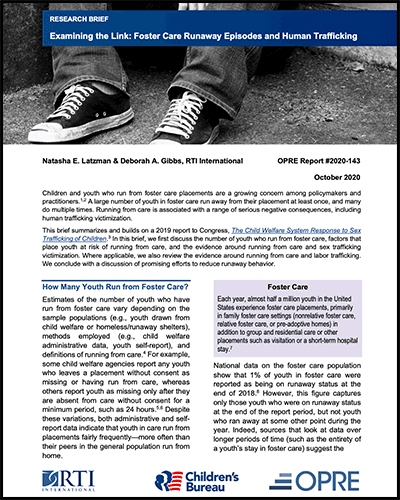
Children and youth who run from foster care placements are a growing concern among policymakers and practitioners. A large number of youth in foster care run away from their placement at least once, and many do multiple times. Running from care is associated with a range of serious negative consequences, including human trafficking victimization. In this brief, we first discuss the number of youth who run from foster care, factors that place youth at risk of running from care, and the evidence around running from care and sex trafficking victimization. Where applicable, we also review the evidence around running from care and labor trafficking. We conclude with a discussion of promising efforts to reduce runaway behavior.
Presentation by Kevin Bales and Professor Monti Datta on “Estimating the Dark Figure: Slavery and Trafficking”, at the QUB School of Law one day conference: ‘New Frontiers of the Dark Figure: Measuring Hidden Crimes’. Followed by Q&A session.

This is the fifth global report by the United Nations Office on Drugs and Crime (UNODC), mandated by the General Assembly through the 2010 Global Plan of Action to Combat Trafficking in Persons. The report comes at a time when global suffering has vastly increased vulnerabilities to trafficking. Extreme poverty is expected to rise for the first time in decades, with the continuing COVID-19 crisis casting a long shadow over our societies and economies.
Today, two cultural forces are converging to make America’s youth easy targets for sex traffickers. Younger and younger girls are engaging in adult sexual attitudes and practices, and the pressure to conform means thousands have little self-worth and are vulnerable to exploitation. At the same time, thanks to social media, texting, and chatting services, predators are able to ferret out their victims more easily than ever before.
In Walking Prey, advocate and former victim Holly Austin Smith shows how middle class suburban communities are fast becoming the new epicenter of sex trafficking in America. Smith speaks from experience: Without consistent positive guidance or engagement, Holly was ripe for exploitation at age fourteen. A chance encounter with an older man led her to run away from home, and she soon found herself on the streets of Atlantic City. Her experience led her, two decades later, to become one of the foremost advocates for trafficking victims. Smith argues that these young women should be treated as victims by law enforcement, but that too often the criminal justice system lacks the resources and training to prevent the vicious cycle of prostitution. This is a clarion call to take a sharp look at one of the most striking human rights abuses, and one that is going on in our own backyard.

Since the last Global Report on Trafficking in Persons in 2014 there have been a number of significant develop- ments that reinforce this report’s importance, and place it at the heart of international efforts undertaken to combat human trafficking. Perhaps the most worrying develop- ment is that the movement of refugees and migrants, the largest seen since World War II, has arguably intensified since 2014.
Faridoun Hemani is a broadcast journalist, and founder of independent production company Linx Productions. He has been in the television news business for 35 years, and has covered major international stories around the world.

40.3 million people – around 1 in every 185 people alive – experienced modern slavery or forced labour in 2016. Ending modern slavery is central to several targets of the UN Sustainable Development Goals (SDGs), notably Target 8.7. Yet, development sector voices are often notable for their absence from global anti-slavery and anti-trafficking discussions. This study considers a simple question: how can fighting slavery contribute to sustainable development? Over eighteen months, we used comprehensive literature reviews and mapping, quantitative analysis, surveys and mixed methods case studies.
Sunitha Krishnan has dedicated her life to rescuing women and children from sex slavery, a multimilion-dollar global market. In this courageous talk, she tells three powerful stories, as well as her own, and calls for a more humane approach to helping these young victims rebuild their lives.
There were an estimated 40.3 million people in modern slavery in 2016 – 1 in every 185 people. Modern slavery involves some people treating others as if they own them. This involves intentional denial or restriction of victims’ economic agency, even as survivors assert agency in other ways. When one person enslaves another, they prevent them exercising outside labour options, and may control consumption, savings and investment choices. This control can be used to extract a rent, by coercing the victim to work below market wage. Sustainable development and human development have focused on developing people’s capabilities but have assumed people control their own economic agency. That is not always so. Addressing slavery requires a different way of thinking, that seeks to protect and maximize agency.
Lisa Kristine has traveled the world, documenting the unbearably harsh realities of modern-day slavery. She shares hauntingly beautiful images – miners in the Congo, brick layers in Nepal — illuminating the plight of the 27 million souls enslaved worldwide.