Survey Report 2021 of Efforts to Implement OSCE Commitments and Recommended Actions to Combat Trafficking in Human Beings

This 2020 follow-up survey was developed for the purpose of tracking progress made towards the implementation of anti-trafficking commitments since 2015, with specific emphasis on recent Ministerial Council Decisions adopted during the interim. In line with these commitments, the survey features new sections on vulnerability reduction, awareness-raising, and addressing demand, as well as the role of technology in facilitating and combating human trafficking and online sexual exploitation of children. It has also been designed to develop recommendations with consideration to emerging trends, challenges and opportunities in responding to complex, cross-dimensional, and evolving crime of trafficking in human beings.

READ THE REPORT

Guidance Note on addressing the risks of trafficking in human beings related to the war in Ukraine and the ensuing humanitarian crisis

Over five million people have been forced to flee Ukraine in the first two months of the war, seeking refuge in neighbouring countries and onwards across Europe. An estimated 90% of them are women and children. In addition, more than 7.7 million people have been internally displaced (Sources: UNHCR and IOM). This unprecedented movement of people poses significant logistical challenges for public institutions and aid organisations, in particular in countries bordering Ukraine. Front-line civil society organisations, specialised NGOs and journalists have quickly sounded the alarm over suspected cases of human trafficking among people fleeing Ukraine.

READ THE REPORT

Applying Gender-Sensitive Approaches In Combating Trafficking In Human Beings

The relationship between trafficking in human beings (THB) and gender is both intrinsic and complex. Proper attention to the gender dynamics of both the trafficking crime and the response to it can yield more impactful outcomes. On the other hand, failure to understand the relationship between THB and gender leads to inadequate responses that exacerbate stereotypes and create barriers to the provision of protection and assistance to all victims. For this reason, States are required under the Palermo Protocol and other international instruments to adopt and implement gender-sensitive approaches to combating THB.

READ THE REPORT

Compendium of Good Practice Examples to Combat Exploitation in Supply Chains

This Compendium is a product of regional collaboration and cooperation. It brings together knowledge and expertise from the sixteen countries and three international organizations that are members of the Working Group with the aim of facilitating information and knowledge sharing on initiatives to combat exploitation in supply chains to inspire government action on a global scale.

READ THE REPORT

Trafficking In Human Beings And Terrorism: Where and how they intersect

Trafficking in Human Beings and Terrorism: Where and How They Intersect examines yet another evolving area: the con- nection between terrorism and trafficking in human beings. Despite the acknowledgement in various international reports of links between human trafficking and terrorism, there remains a dearth of well-grounded research on them, as well as a scarcity of policy guidelines for effectively tackling both crimes while protecting victims.

READ THE REPORT

CCC / Code 8.7: Applying AI in the Fight Against Modern Slavery

At the same time they help us, technologies that increase surveillance of populations can also undermine basic human rights. The IEEE Global Initiative on Ethics of Autonomous and Intelligent Systems [IEEE2020] recently put forward a number of Artificial Intelligence responses to consider in light of the unique challenges brought about by the COVID-19 pandemic; community health and crimes like trafficking share a number of important parallels when AI methods are brought to bear

READ THE REPORT

Multidisciplinary Collaborative Model for Anti-Human Trafficking Task Forces – Development and Operations Roadmap

Since 2004, the U.S. Department of Justice has provided federal funding to support the multidisciplinary task force approach. These task forces uphold the intent of the Trafficking Victims Protection Act (TVPA) by ensuring that all trafficking victims are identified and receive access to a comprehensive array of supportive services, and that the crimes of human trafficking are successfully investigated and prosecuted at the local, state, tribal, and federal levels.

READ THE REPORT

U.S. Department of State Trafficking in Persons (TIP) Report 2022

Everyone should be free. And yet, through force, fraud, and coercion, human traffickers violate this most basic right. Traffickers’ exploitative practices affect every country in the world, including the United States, by diminishing and destroying our communities, sense of security, and the global economy. This year’s Trafficking in Persons Report turns the spotlight to more clearly illuminate the impact of human trafficking on our global community and on actions we can take as individuals, and as a society, to combat this deplorable crime everywhere it occurs, especially in the most at-risk communities.

READ THE REPORT

U.S. Department of State Trafficking in Persons (TIP) Report 2021

This year’s Trafficking in Persons Report sends a strong message to the world that global crises, such as the COVID-19 pandemic, climate change, and enduring discriminatory policies and practices, have a disproportionate effect on individuals already oppressed by other injustices. These challenges further compound existing vulnerabilities to exploitation, including human trafficking. We must break this inhumane cycle of discrimination and injustices if we hope to one day eliminate human trafficking.

READ THE REPORT

IOM World Migration Report 2022

Human migration and mobility may well be age-old phenomena touching almost every society around the world. However, they have changed over time in important ways. Examining these shifts in scale, direction, demography and frequency can help us understand how migration is evolving, and can inform effective policies, programmes and operational responses on the ground.

READ THE REPORT

Implementation of the non-punishment principle

In the report, the Special Rapporteur analyses current challenges in the implementation of the principle of non-punishment. The principle of non-punishment constitutes the cornerstone of an effective protection of the rights of victims of trafficking, however, its non-implementation or deficient implementation measures that deviate the principle from its intended result are still common practice. In the present report, the Special Rapporteur takes stock of previous research conducted under the mandate, as well as submissions of examples of good practices by Member States and the expertise of practitioners.

READ THE REPORT

The Forced Labour Protocol Guide

The Forced Labour Protocol represents a vital opportunity for trade unions and their allies to obtain, through social dialogue and action, measures to end exploitative labour practices and to advance opportunities for decent work. Forced labour and human trafficking are products of the political economies in which they occur. That is, they emerge from the nature of the laws, policies and practices that govern employment, business and trade. Understanding the nature of the political economy of forced labour can enable trade unions and human rights activists to adapt advocacy strategies to advance decent work through appropriate national and international channels.

READ THE REPORT

Evaluation of the Domestic Victims of Human Trafficking Program: Final Report

To improve services for domestic victims of human trafficking, the Office on Trafficking in Persons (OTIP), within the Administration for Children and Families (ACF) of the U.S. Department of Health and Human Services, awarded 13 three-year cooperative agreements in 2016 to nongovernmental organizations across the United States. This report documents the experiences of 12 grantees1 that implemented DVHT projects in Alaska, Arizona, Arkansas, California, Illinois, Louisiana, Massachusetts, Michigan, New Jersey, Ohio, Oregon, and Utah. ACF’s Office of Planning, Research, and Evaluation (OPRE), in collaboration with OTIP, oversaw a cross-site process evaluation of these projects conducted by RTI International.

READ THE REPORT

Human Trafficking Center Code of Conduct

Religious groups have long been vocal proponents in the U.S.-based movement against human trafficking and contemporary slavery. Moreover, religious commitments and motivations are an invaluable resource in sustaining this kind of immensely difficult human rights work, Thus there is unquestionably a critical role for religious organizations, faith communities, and faith-based organizations to play in bringing modern slavery to an end.

READ THE REPORT

AGGRAVATING CIRCUMSTANCES: how coronavirus impacts human trafficking

The coronavirus is not only claiming hundreds of thousands of lives, but is also causing a global economic crisis that is expected to rival or exceed that of any recession in the past 150 years. Poverty, lack of social or economic opportunity and limited labour protections are the main root causes and drivers that render people vulnerable or cause them to fall victim to human trafficking.

READ THE REPORT

EXECUTIVE SUMMARY: Road to Recovery: Nine anti-trafficking organizations share pivots and emerging best practices in response to COVID-19 disruption

Crisis doesn’t make an appointment. The crisis of a global pandemic was no exception to the rule. Anti-trafficking organizations across the world have been forced to innovate and adapt both during COVID-19 and in post-crisis. Now is the time, more than ever, to share the field’s inventive and iterative approach to recovery.

READ THE REPORT

Road to Recovery: Nine anti-trafficking organizations share pivots and emerging best practices in response to COVID-19 disruption

Crisis doesn’t make an appointment. The crisis of a global pandemic was no exception to the rule. Anti-trafficking organizations across the world have been forced to innovate and adapt both during COVID-19 and in post-crisis. Now is the time, more than ever, to share the field’s inventive and iterative approach to recovery.

READ THE REPORT

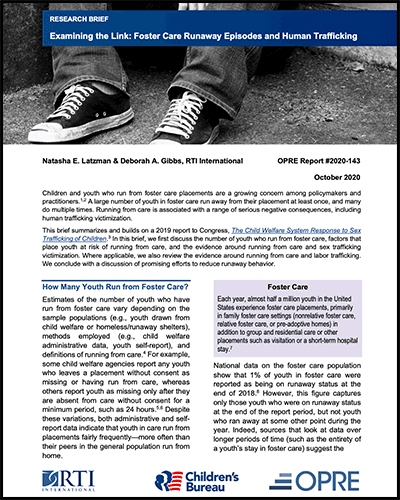
Examining the link: Foster care runaway episodes and human trafficking

Children and youth who run from foster care placements are a growing concern among policymakers and practitioners. A large number of youth in foster care run away from their placement at least once, and many do multiple times. Running from care is associated with a range of serious negative consequences, including human trafficking victimization. In this brief, we first discuss the number of youth who run from foster care, factors that place youth at risk of running from care, and the evidence around running from care and sex trafficking victimization. Where applicable, we also review the evidence around running from care and labor trafficking. We conclude with a discussion of promising efforts to reduce runaway behavior.

READ THE REPORT

UNODC Global Report on Trafficking in Persons 2020

This is the fifth global report by the United Nations Office on Drugs and Crime (UNODC), mandated by the General Assembly through the 2010 Global Plan of Action to Combat Trafficking in Persons. The report comes at a time when global suffering has vastly increased vulnerabilities to trafficking. Extreme poverty is expected to rise for the first time in decades, with the continuing COVID-19 crisis casting a long shadow over our societies and economies.

READ THE REPORT