2016 Freedom From Slavery Forum Report

The Freedom from Slavery Forum was designed to provide a place for leaders of the global anti-human trafficking and anti-slavery movement to come together, share and discuss best practices and lessons learned, identify gaps in the field, brainstorm new ideas, and build relationships with one another. Additionally, the Forum is meant to educate the public about this issue. Accordingly, the 2016 Forum was a two day event comprised of private meetings among anti-slavery experts, followed by a public panel discussion on the ways the electronics and fishing industries deal with issues of slavery and trafficking in their supply chains.
READ THE REPORT

Understanding and Responding to Modern Slavery within the Homelessness Sector

Homelessness organisations and anti-slavery organisations have both been aware of links between modern slavery and homelessness, yet there has been little research into how these issues overlap and impact on one another. An initial scoping exercise was, therefore, commissioned in 2016 by the UK’s Independent Anti-Slavery Commissioner, Kevin Hyland OBE, to gain a better understanding of modern slavery within the homelessness sector. The Passage, a leading homelessness charity, was appointed to look into this issue.

READ THE REPORT

“IF I COULD GO TO SCHOOL…”

Girl soldiers in Democratic Republic of Congo (DRC) experience severe hardships – both in the ranks of armed groups and after returning home. Programmes that support the release, recovery and reintegration of girl soldiers have so far been woefully inadequate. Only a small percentage of girls leave armed groups through formal demobilisation processes, and an even smaller number receive any assistance. Following extensive consultations with DRC-based child protection partners in 2012-2015, Child Soldiers International travelled to eastern DRC in early 2016. We conducted interviews with 150 former girl soldiers, and spoke to community and child protection representatives. Our ?ndings will form a set of best practice principles to improve assistance to former child soldiers, with a particular focus on the speci?c needs of girls.

READ THE REPORT

Financing Forced Labor

Sixty years have passed since the adoption of ILO Convention No. 105 (Abolition of Forced Labor Convention, 1957), yet a number of States have persisted in using forced labor for economic development, the eradication of which was a driving force behind establishing the Convention. Nowhere in the world is this problem more entrenched and pervasive than Uzbekistan.

READ THE REPORT

Human Trafficking and Public Corruption

Corruption is an endemic feature of human trafficking. It is common to both sex and labour trafficking. Corruption enables traffickers’ often-successful efforts to evade justice. Examples abound: a police officer demands a bribe to ignore the presence of a child in a brothel; an immigration official receives payment to provide a forged passport; a judge dismisses a trafficking case in exchange for a share of the traffickers’ profits; a law enforcement official deports a trafficking victim to prevent her testimony against a criminal defendant; a government official accepts a bribe to fraudulently provide residency permits for foreign workers.

READ THE REPORT

Food & Beverage Benchmark Findings Report: How are 20 of the largest companies addressing forced labor in their supply chains?

The food and beverage industry is an at-risk sector. Forced labor occurs both in the production of raw materials and during the food processing stages of food and beverage companies’ supply chains. Food commodities are produced by agricultural workers who often come from vulnerable groups such as women, international migrants, and internal migrants with little education. Weak labor laws and law enforcement in the sector, together with isolated workplaces where housing tends to be provided by the employer, aggravate the typically poor working conditions and can leave workers vulnerable and dependent on their employer.

READ THE REPORT

Fighting human trafficking in conflict: 10 Ideas for Action by the United Nations Security Council

Workshop Participants considered that the role of the Security Council will need to vary, depending on the nature of the human trafficking activity. In some cases, it may be direct and disruptive. In others it may be more normative, or may involve shaping the UN’s field response. In each of these areas, the Security Council can also take action to encourage and support other actors – Member States, regional organizations, the private sector-to pay attention to and address human trafficking in conflict.

READ THE REPORT

MÁS QUE BEBIDAS A LA VENTA: Desvelando Las Redes de Trata Sexual en Bares Y Cantinas Estadounidenses

Miles de mujeres latinas o hispanas son prisioneras de la industria de la trata sexual en bares y establecimientos tipo cantina a lo largo de los Estados Unidos. Son reclutadas y controladas por redes criminales, propietarios de negocios o tratantes independientes. Las engañan y seducen con promesas de relaciones románticas, buenos empleos y cruce seguro por la frontera hasta los Estados Unidos. Otras mujeres y niñas se ven forzadas a vender sexo por sus padres, familiares o parejas sentimentales.

Leer el Informe

MORE THAN DRINKS FOR SALE: Exposing Sex Trafficking in Cantinas & Bars in the U.S.

Based on data from the National Human Trafficking Resource Center (NHTRC) hotline and Polaris’s BeFree Textline, More than Drinks for Sale sheds light on the unseen realities faced by young women and girls from Latin America who are trapped in an underground sex economy operating out of cantinas and bars across the U.S. – and why their traffickers remain largely untouched.

READ THE REPORT

Products of Slavery and Child Labour

Child labour is defined as work that deprives children of their childhood and the opportunity to attend school, and that is harmful to their physical and mental development. Forced labour all work or service which is exacted from any person under the menace of any penalty and for which the worker does not offer himself or herself voluntarily.

Anti-Slavery International is the only UK-based charity exclusively working to eliminate all forms of slavery and slavery like practices throughout the world.

READ THE REPORT

“I Was Sold”: Abuse and Exploitation of Migrant Domestic Workers in Oman

This report is based on research conducted in Oman in May 2015 by two Human Rights Watch researchers. They conducted interviews in Muscat, the Omani capital, and Seeb, a nearby coastal city, which have high concentrations of recruitment agencies and families employing domestic workers, and where many domestic workers fled after abuse by employers from other parts of Oman.

READ THE REPORT

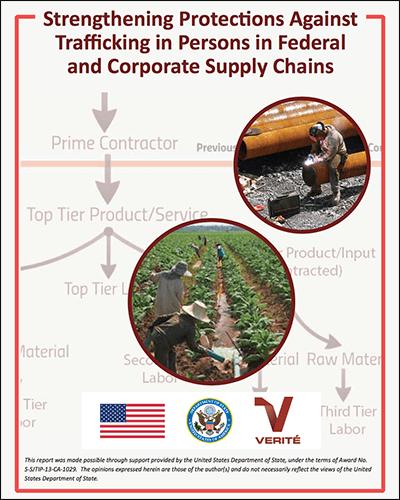
Strengthening Protections Against Trafficking in Persons in Federal and Corporate Supply Chains

The EO requires prime contractors providing large overseas contracts to develop and maintain detailed anti-trafficking compliance programs and provide annual certification of their anti- trafficking efforts.

To assist United States Government agencies and the federal contracting community to prepare for implementation of the EO and new FAR rules, the United States Department of State’s Office to Monitor and Combat Trafficking in Persons (DOS/J/TIP) asked Verité to investigate and map out the risk of trafficking in global supply chains generally, and in federal supply chains in particular.

READ THE REPORT

2016 Global Slavery Index Report

Slavery is abhorrent, more rampant than at any time in history, and entirely avoidable. Unlike major world epidemics such as malaria and HIV/AIDS, slavery is a human condition of our own making. While that in itself is a tragedy, it also means that we have the power to end it. And end slavery we must; we cannot allow future generations to fall prey to this hideous practice.

READ THE REPORT

2014 Report to the Texas Legislature Human Trafficking Prevention Task Force

In conjunction with dedicated members of the Texas Legislature, the Task Force has helped Texas become and remain a leader in anti-trafficking efforts. Shared Hope International, a leading anti-trafficking organization, awarded Texas some of the highest rankings in the nation in 2013 and 2014 in its annual Protected Innocence Challenge. Texas received perfect scores for its efforts to criminalize domestic minor sex trafficking and provide criminal justice tools for investigation and prosecution of trafficking cases. Additionally, the state received near perfect scores for its work related to criminal provisions addressing demand and criminal provisions for traffickers.

READ THE REPORT

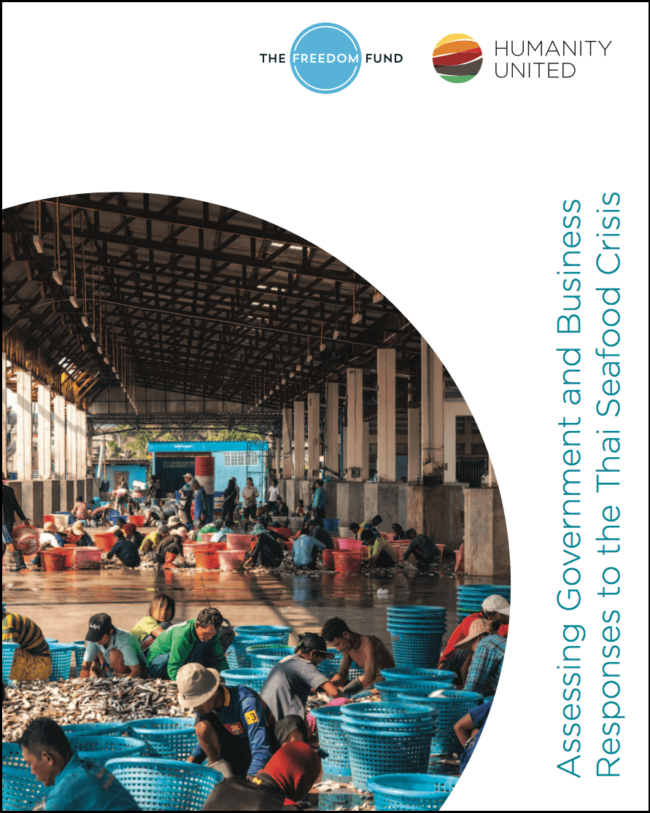
Assessing Government and Business Responses to the Thai Seafood Crisis

International focus on the Thai seafood industry has rapidly increased in recent years. The last two years in particular have seen a series of high profile reports that have damaged the industry’s reputation and put pressure on the Thai government. In June 2014, a six-month investigation by the Guardian newspaper culminated in an exposé linking one of Thailand’s largest companies and a number of leading American and European retailers to sh caught by slaves, which was used to feed the farmed shrimp they sold in the US and EU.

READ THE REPORT

U.S. Department of State Trafficking in Persons (TIP) Report 2016

This year’s Report underscores the need for increased attention to preventing human trafficking. It encourages governments to identify and acknowledge those most at-risk in society, and to create effective ways to recognize vulnerable populations and help first responders spot the methods used by human traffickers. By understanding the needs of vulnerable groups, governments can partner with NGOs and the private sector to protect the innocent from would-be traffickers.

READ THE REPORT

Manual for Experts on Multidisciplinary Cooperation Against Trafficking in Human Beings for Labour Exploitation

Aimed at experts and intended to help inspire and strengthen the policy and practice to address trafficking in human beings (THB) for labour exploitation of all organisations that could come across it. More specifically, it aims to stimulate multidisciplinary and cross-border cooperation and a comprehensive approach against this phenomenon. Expertise and ideas from experts from all Member States were collected as input for the manual. It contains knowledge and expertise on THB for labour exploitation from all over the European Union.

READ THE REPORT