
U.S. Department of State Trafficking in Persons (TIP) Report 2009
The Trafficking in Persons (TIP) Report is the U.S. Government’s principal diplomatic tool to engage foreign governments on human trafficking.

The Trafficking in Persons (TIP) Report is the U.S. Government’s principal diplomatic tool to engage foreign governments on human trafficking.

The Trafficking in Persons (TIP) Report is the U.S. Government’s principal diplomatic tool to engage foreign governments on human trafficking.

The Trafficking in Persons (TIP) Report is the U.S. Government’s principal diplomatic tool to engage foreign governments on human trafficking.

The Trafficking in Persons (TIP) Report is the U.S. Government’s principal diplomatic tool to engage foreign governments on human trafficking.

Identifies the use of slavery-like practices involved in the manufacture of garments in India for international markets: the use of forced labour of young women and girls in the factories of Southern India, particularly the spinning mills around Tirupur. Also identifies the routine use of child labour in garment finishing in Delhi. Details of international companies whose supply chains appear to be affected by some of these forms of forced labour are given in chapter four of this report.

A study of the reasons why bonded labour, a contemporary form of slavery, persists in India, Nepal and Pakistan. In particular, it examines the effectiveness of state interventions against bonded labour.
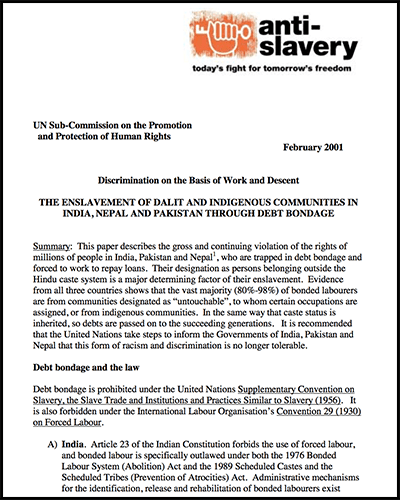
Describes the gross violation of the rights of millions of people in India, Pakistan and Nepal who are trapped in debt bondage and forced to work to repay loans. It explores evidence which shows that 80-98 per cent of bonded labourers are from communities designated as dalits.

Reviews the literature available on child marriage to show that a potentially high proportion of children in marriage are in slavery. Deploys a wealth of material already available on the subject of child marriage to present how many of these real-life incidences in fact amount to slavery and slavery-like practices under international law, based on a thorough analysis of the most relevant UN and ILO standards.

Based on interviews with around 3,000 children the report is a study into the psychosocial wellbeing of child domestic workers across six countries in three continents (Peru, Costa Rica, Togo, Tanzania, India and Philippines).

Examines the practice in daaras (Koranic schools) of sending boys as young as five years old out to beg for several hours a day. Often living far from home and in squalid conditions, talibés are frequently subjected to abuse if they fail to meet their begging quotas.

Finds that trafficking of children to cocoa farms in Côte d’Ivoire still occurs. The research found significant numbers of young people in Mali and Burkina Faso who had worked as children in cocoa farms in Côte d’Ivoire in the last five years. The practices occur in the context of large-scale movements of people within the region including the trafficking of children to other agricultural activities and to other sectors.

Based on research conducted in Albania and Greece, India and Senegal, and looks at the phenomenon of forced child begging both in its local specifics and global commonalities. Forced child begging involves forcing boys and girls to beg through physical or psychological coercion.

A toolkit outlining qualitative methods for researchers interested in exploring the more exploitative and damaging forms of child begging, where children have been physically forced or coerced into their work.

The product of group discussions and individual interviews with more than 400 current and former child domestic workers from urban and rural areas in Benin, Costa Rica, India, Nepal, Peru, Philippines, Tanzania and Togo, to inform about the situation and needs of child domestic workers in order to better target programmes and policies on the issue.

A collaboration between governments, bilateral institutions, international and non-governmental organisations has resulted in the development of this code of conduct, which aims to encourage improved working conditions and treatment of child domestic workers and child victims of trafficking.

Provides an in-depth analysis of how cocoa is produced and how child and slave labour enter its chain of production. It relates the history of cocoa and explores how this commodity fits within a global market. Drawing on a wide range of sources, it concludes with recommendations for consumers, the chocolate industry and governments on actions needed to address this serious problem.

Produced by Anti-Slavery International for organisations wanting to persuade governments to take action against child labour. It explains clearly how and why to use international monitoring and complaints procedures to encourage governments to respect their obligations regarding child rights.

Six-page report investigates how discrimination works as a cause and a consequence of child labour. NGO Group for the Convention on the Rights of the Child Sub-Group on Child Labour 2002.

Draws on the experience of activists from 17 countries and representatives of internaitonal and regional agencies who attended a workshop that Anti-Slavery International convened in April 2001. A practical “how to” guide which will help local level NGOs and activists plan, design, implement and evaluate the impact of an advocacy strategy on child domestic workers.

A 24-page brochure on how this convention creates new opportunites for civil society organisations. The brochure focuses on involvement in ratification and implementation of the Convention in an easy to read and lively format.

Practical “how to” guide draws on the experiences and views of non-governmental organisations and others working with child domestics in Asia, Africa and Latin America, offering useful insights for anyone who wants to help the children concerned.

Focuses on returned North Korean migrants who are subjected to forced labour in North Korean prison camps following their deportation from China. The findings of the report are based on interviews carried out with North Koreans who were subjected to forced labour while in detention. The report includes photographs and 30 cases. Most of those interviewed were subjected to forced labour before being prosecuted, which violates international standards as well as North Korea’s domestic law. The report also outlines what measures need to be taken to address this situation.

Report on a study in the UK, Ireland, the Czech Republic and Portugal. This report looks at the various sectors and industries in which trafficking into forced labour occurs including agriculture, construction, domestic work and hospitality. Includes policy recommendations at a European level.

Result of research carried out by Anti-Slavery International between 2005 and 2006 with the aim of finding out more about trafficking for forced labour in the United Kingdom. This was a qualitative rather than quantative project, which aimed to provide information about how migrants become trafficked and which industries in the UK are affected.

Investigates the experiences of migrant domestic workers in the region, the dynamics and workings of the migration process and how migration (if at all) contributes to trafficking; and looks at what are some of the key inter-connecting dynamics involved between slavery, trafficking, migration and forced labour.
It focuses particularly on several selected sending, receiving and transit countries (Egypt, Ethiopia, Eritrea, Lebanon, Sudan and Yemen).