Ending child labour, forced labour and human trafficking in global supply chains

This report presents the joint research findings and conclusions on child labour, forced labour and human trafficking linked to global supply chains from the ILO, the Organisation for Economic Co-operation and Development (OECD), the International Organization for Migration (IOM), and the United Nations Children’s Fund (UNICEF), under the aegis of Alliance 8.7. It is the first attempt by international organizations to measure child labour, forced labour and human trafficking in global supply chains.

READ THE REPORT

Ethical Recruitment: Translating Policy into Practice

Improving the practices involved in the recruitment of international migrant workers is a priority for companies, governments, and non-governmental organisations seeking to address forced labour risks. However, to date, there has been little publicly accessible information covering the challenges and achievements of real-world attempts to make responsible recruitment a reality. Global seafood producer Thai Union (TU) began implementing its Ethical Migrant Recruitment Policy (the Policy) in 2016. In order to understand the successes and challenges of TU’s efforts, Humanity United and the Freedom Fund commissioned Impactt to conduct an independent, six-month evaluation in 2018.

READ THE REPORT

Workers’ Rights in Supermarket Supply Chains: New Evidence on the Need for Action

This Oxfam briefing note presents compelling new evidence that our food supply chains are rife with violations of human, labour and women’s rights. The paper summarizes new research commissioned by Oxfam, which shows the depth and scale of human suffering in food production in India and Brazil among workers linked to international supermarket supply chains. The briefing note identifies company laggards on workers’ rights, makes clear that progress is possible and where it is being made, and puts forward a framework for action with important steps for supermarkets to take to end human suffering in their supply chains.

READ THE REPORT

Rohingya refugees’ perspectives on their displacement in Bangladesh: Uncertain futures

While there is good understanding of the short-term needs of Rohingya refugees and their perspectives, this does not appear to be informing planning for the medium term. This paper – based on qualitative and quantitative research with Rohingya refugees in Bangladesh – provides insight into the current political and policy context, refugees’ challenges and aspirations, community engagement and what could improve refugees’ lives in the medium to long term.

READ THE REPORT

Review of Models of Care for Trafficking Survivors in Thailand

This report summarizes the findings of a Review of Models of Care for Trafficking Survivors that was completed by Winrock International (Winrock) in 2018-2019 under the United States Agency for International Development’s Thailand Counter Trafficking-in-Persons project. The research aimed to compare models of care available to trafficked persons (men, women, girls and boys, and lesbian, gay, bisexual, transgender, queer, and intersex [LGBTQI] people) in Thailand, and assess their relative effectiveness in victim recovery. The study also explored models used elsewhere that could be adapted to the Thailand context.

READ THE REPORT

Agriculture and Modern Slavery Act Reporting: Increasing engagement but poor quality from a high risk sector

The agricultural sector is considered high risk for forms of labour exploitation, including modern slavery. The International Labour Organisation places agriculture, alongside forestry and fishing, as the sector with the fourth highest proportion of victims of forced labour worldwide.i Within the UK, there is a lack of formal data on the prevalence of slavery within agriculture. However, the characteristics of work within this sector – tasks which are easily replicable and labourers thus easily replaceable, and a reliance on low-skilled seasonal labour – create vulnerability to modern slavery and other forms of exploitation.

READ THE REPORT

Stolen freedom: the policing response to modern slavery and human trafficking

In the UK, today and every day, thousands of men, women and children who are victims of modern slavery and human trafficking are being degraded and dehumanised. These crimes are multi-faceted. Cases may involve single or multiple offenders or victims, and may be national or international, organised or opportunistic. They occur in both rural and metropolitan areas, in settings ranging from nail bars to construction sites, and involve activities from domestic servitude to the trafficking of children for sexual exploitation. It is imperative that police forces are aware of the signs and indicators of these most pernicious and frequently hidden of crimes so that they can respond in an appropriate manner.

READ THE REPORT

2017 Federal Human Trafficking Report

The 2017 Federal Human Trafficking Report represents a long-lasting desire to capture and analyze what federal courts in the United States are doing to combat human trafficking. The Human Trafficking Institute undertook this project with the ambitious goal of capturing an exhaustive list of all the criminal and civil human trafficking cases in the United States. Through the tireless work of the Institute’s team members, this Report contains wide-ranging information about every human trafficking case that federal courts handled during 2017.

READ THE REPORT

Service Recommendations for Human Trafficking Survivors With Substance Use Disorders

This document was developed by fellows of the 2018 Human Trafficking Leadership Academy (HTLA) organized through the National Human Trafficking Training and Technical Assistance Center (NHTTAC) and Coro Northern California. A team of six non-government service providers and six survivor leaders worked together to develop recommendations on how to enhance service provision to survivors of human trafficking or those at risk of human trafficking using trauma-informed practices and survivor-informed principles.

READ THE REPORT

UNODC Global Report on Trafficking in Persons 2018, Booklet 2: Trafficking in Persons in the Context of Armed Conflict

In 2016, more countries were experiencing some form of violent conflict than at any other time in the previous 30 years. People living in conflict-affected areas may experience abuse, violence and exploitation, including trafficking in persons. The risk of trafficking in persons is also connected with the high numbers of refugees. A need to flee war and persecution may be taken advantage of for exploitation by traffickers.

READ THE REPORT

UNODC Global Report on Trafficking in Persons 2018

The Global Report on Trafficking in Persons 2018 puts thespotlight on human trafficking in armed conflict. Humantrafficking is always a crime, committed with the intention to exploit; in conflict situations, characterized by violence, brutality and coercion, traffickers can operate with even greater impunity. Trafficking in armed conflict has taken on horrific dimensions – child soldiers, forced labour, sexual slavery.

READ THE REPORT

Modern Slavery, Environmental Destruction and Climate Change: Fisheries, Field, Forests and Factories

Modern slavery and climate change have emerged as concurrent crises in the contemporary world. While these phenomena have been well-established separately in recent academic and policy-based debates, little discussion has taken place on the interconnections between them. An emerging area of research has begun to interrogate aspects of the nexus between modern slavery, environmental destruction and climate change, but a review of the existing literature in the area remains lacking.

READ THE REPORT

BLOOD BRICKS: Untold Stories of Modern Slavery and Climate Change from Cambodia

In Cambodia, as in many other countries, economic growth has not led to decent work for all. In fact, quite the opposite scenario has been unfolding over the past years: Poor farmers who are unable to earn a living from agriculture as a consequence of climate change move to urban and peri-urban areas and become victims of forced and of bonded labour which are contemporary forms of slavery. In this way, the economic growth which flourishes due to a booming construction industry has created in itself a trap for the poor and vulnerable. It is a vicious cycle which is enabled by development which is not sustainable. Not for the environment and not for the people who are behind it. To break this vicious and dangerous cycle, the interlinkages between contemporary forms of slavery and climate change need to be understood by the government of Cambodia in order to create viable alternatives. The present report illustrates these linkages in an eye-opening way, shedding light on a so far scarcely researched yet so essential subject.

READ THE REPORT

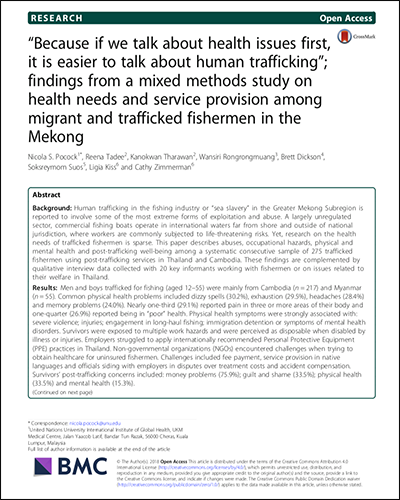
“Because if we talk about health issues first, it is easier to talk about human trafficking”; findings from a mixed methods study on health needs and service provision among migrant and trafficked fishermen in the Mekong

Human trafficking in the fishing industry or “sea slavery” in the Greater Mekong Subregion is reported to involve some of the most extreme forms of exploitation and abuse. A largely unregulated sector, commercial fishing boats operate in international waters far from shore and outside of national jurisdiction, where workers are commonly subjected to life-threatening risks. Yet, research on the health needs of trafficked fishermen is sparse.

This paper describes abuses, occupational hazards, physical and mental health and post-trafficking well-being among a systematic consecutive sample of 275 trafficked fishermen using post-trafficking services in Thailand and Cambodia. These findings are complemented by qualitative interview data collected with 20 key informants working with fishermen or on issues related to their welfare in Thailand.

READ THE REPORT

FACT SHEET: Human Trafficking and Health Care Providers

Health care providers have an important, proactive role to play in combating human trafficking in the United States. With proper training, health care providers can play a significant part in identifying and caring for trafficking victims.4 Medical personnel can also document injuries, testify as expert witnesses, and provide affidavits for submission in legal cases. But in order to be able to identify trafficking cases, health care providers must be familiar with red flags and trafficking indicators.

This fact sheet highlights medical components of case studies drawn directly from federal criminal indictments and civil trafficking complaints. These case studies provide documented incidents that illustrate how human trafficking has presented in health care settings. It is hoped that these concrete examples gleaned from legal cases will assist medical professionals in recognizing red flags and risk factors.

READ THE REPORT

U.S. Legal Remedies for Minor Victims of Sex Tourism and Sex Trafficking

In 2003, the United States Congress passed a law to fight sex tourism and sexual abuse of children. Congress titled the law the Prosecutorial Remedies and Other Tools to End
the Exploitation of Children Today (“PROTECT”) Act.1 Under the PROTECT Act, any U.S. citizen or legal permanent resident who sexually abuses or exploits children, anywhere in the world, can be held accountable in U.S. federal courts….

READ THE REPORT

Time to break old habits: Shifting from Complicity to Protection of the Rohingya in Myanmar

This study outlines the need for the international community in Myanmar to dramatically change gears in their approach if they are to break out of a cycle of passive complicity with ethnic cleansing and make a more lasting contribution to protecting the persecuted Rohingya Muslim minority in Myanmar. The article analyzes years of secrecy, self-censorship and silent compliance with government policies of abuse. It calls on all actors to engage in more forthright reporting and advocacy, confronting government harassment more boldly. It further urges donors and agencies to stop all support to ethnic detention centres and to strictly condition all their future contributions and programming in Myanmar – linking such support to the granting of freedom of movement and other rights to the Rohingya.

READ THE REPORT

U.S. Department of State Trafficking in Persons (TIP) Report 2018

This year’s report focuses on effective ways local communities can address human trafficking proactively and on how national governments can support and empower them. Local communities are the most affected by this abhorrent crime and are also the first line of defense against human trafficking. By engaging and training law enforcement, religious leaders, teachers, tribal elders, business executives, and communities, we become more vigilant and learn to identify and address vulnerabilities swiftly. Proactive community-driven measures strengthen our ability to protect our most vulnerable and weaken a criminal’s ability to infiltrate, recruit, and exploit.

READ THE REPORT

U.S. Department of State Trafficking in Persons (TIP) Report 2017

In particular, the introduction of this year’s Report focuses on the responsibility of governments to criminalize human trafficking and hold offenders accountable. To that end, this Report is intended to assist governments in identifying threats so law enforcement agencies around the world can respond effectively and gain insight into where human trafficking remains most severe. The Report will also equip local and sub-national law enforcement agencies to better assist in efforts to target and prosecute those who commit these terrible crimes.

READ THE REPORT

Watch video of the announcement ceremony HERE

How Footwear Companies and Luxury Brands Tackle Forced Labor Risks in Their Leather Supply Chains

This case study assesses how a sample of five footwear companies and five luxury clothing brands address forced labor risks across their leather supply chains. The study follows KnowTheChain’s first apparel and footwear benchmark which found a lack of transparency and action to address forced labor abuses beyond first-tier suppliers, particularly in leather.

READ THE REPORT

The Freedom Fund Annual Impact Report 2016

More organisations are joining the anti-slavery movement, and forward-looking businesses are beginning to seriously tackle the risks of slavery in their supply chains. But so much more remains to be done, with an estimated 46 million people still enslaved and exploited around the world. At the Freedom Fund, our focus has been on dismantling the local and national systems that enable slavery in countries with the heaviest burden of this crime.

READ THE REPORT

Forced Labor Action Compared: Findings From Three Sectors

Last year, KnowTheChain identified three sectors with the highest risk of forced labor in their supply chains and benchmarked 60 companies within those sectors. It was the first analysis of its kind, focusing specifically on forced labor risks and the corporate policies and practices developed by companies in response. In order to build on the momentum of this first set of reports, KnowTheChain worked to identify lessons and recommendations that can benefit companies across all sectors. This report is the product of those efforts.

READ THE REPORT

The Typology of Modern Slavery: Defining Sex and Labor Trafficking in the United States

Polaris analyzed more than 32,000 cases of human trafficking documented between December 2007 and December 2016 through its operation of the National Human Trafficking Hotline and BeFree Textline. This is the largest data set on human trafficking in the United States ever compiled and publically analyzed. The Typology of Modern Slavery offers a map for taking the next steps in creating a world without slavery.

READ THE REPORT

The Modern Day Slavery Survey 2017 Report

The Modern Day Slavery Survey 2017 was designed to shed light on the working practices of supply chain and procurement professionals in their attempts to comply with the Modern Slavery Act 2015. Since the introduction of the Act in 2015, anecdotal evidence from UK businesses has given a glimpse into the dif cult situation procurement, supply chain and HSE teams have been placed into, to ensure they are complying with this new legislation. This report on Modern Day Slavery proves where businesses are currently failing and what they anticipate to do to ensure full compliance in the future.

LINK TO FORM TO DOWNLOAD THE REPORT