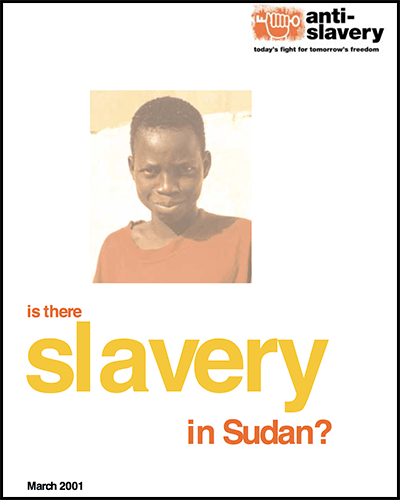
Is There Slavery in Sudan?
Summarises information obtained during a fact-finding visit to investigate abductions and slavery in Sudan. It includes illustrated case studies and the Sudan Government’s response.

Summarises information obtained during a fact-finding visit to investigate abductions and slavery in Sudan. It includes illustrated case studies and the Sudan Government’s response.

Prepared for Anti-Slavery International by Lin Chew, in co-operation with the International Labour Organization’s Special Action Programme to Combat Forced Labour.

To improve the protection of child victims in anti-trafficking efforts, UNICEF developed the Guidelines on Protection of the Rights of Child Victims of Trafficking. The Guidelines outline the minimum standards for safe-guarding the rights of child victims of trafficking at each stage of anti-trafficking interventions.

The Toolkit is based on the premise that the problem of trafficking in persons, whether at the national or local level, can only be addressed effectively on the basis of comprehensive strategies that are based on human rights and that take into account the transnational nature of the problem, the many associated criminal activities, the frequent involvement of organized criminal groups and the profound pain, fear and damage suffered by the victims.

Using a new and improved statistical methodology, the ILO estimates that 20.9 million people are victims of forced labour globally, trapped in jobs into which they were coerced or deceived and which they cannot leave.

The Catholic Church has condemned human trafficking and has developed social service programs to serve and protect its survivors.
Examines the effectiveness of trafficking investigations and prosecutions through the UK Criminal Justice System (CJS)3 in terms of law, policy and practice. In particular, the report focuses on: Obstacles that impede an effective criminal justice response to trafficking; The UK’s ability to ensure its obligations to protect trafficked persons participating in criminal proceedings; Adherence to the requirement not to criminalise trafficked persons; and presenting examples of good practice from within the UK and abroad wherever possible.

Focuses on the importance of effective victim identification, and on those approaches and policies that have succeeded in bringing victims out of the darkness of exploitation. The Report outlines specific steps officials should take—from legislators and judges to police officers and border guards—to make sure the victims of this crime don’t go unrecognized. And it illustrates why identifying victims by itself is not enough—they need to be given a true voice in the process.
Watch the video of the announcement ceremony HERE.

The New York State Legislature required the New York State Office of Children and Family Services (OCFS) to develop a comprehensive study that: (1) estimates the prevalence of sexually exploited children within New York State, (2) identifies the unique needs of sexually exploited children, (3) specifies the types of programs and services that best meet such needs, and (4) evaluates the capacity of the current children’s service system to meet the needs of commercially sexually exploited children (CSEC).
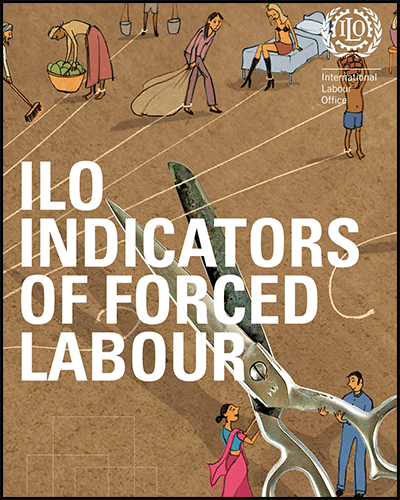
Presents an introduction to the ILO Indicators of Forced Labour. These indicators are intended to help “front-line” criminal law enforcement officials, labour inspectors, trade union officers, NGO workers and others to identify persons who are possibly trapped in a forced labour situation, and who may require urgent assistance. The indicators represent the most common signs or “clues” that point to the possible existence of a forced labour case.

Five case countries (Belgium, France, Hungary, Italy and the United Kingdom) have been assessed for the purposes of this project, and it is also useful to enquire as to whether any of these countries offer specific examples of effective measures for the integration of victims. As the research for this project has benefitted from some interviews with victims of trafficking, we can also qualitatively address those measures which victims themselves consider satisfactory.
Graphic-based report of the state of human trafficking in the EU.

Trafficking in human beings is a complex transnational phenomenon rooted in vulnerability to poverty, lack of democratic cultures, gender inequality and violence against women, conflict and post-conflict situations, lack of social integration, lack of opportunities and employment, lack of access to education, child labour and discrimination.

To increase the knowledge base on this important issue, the ILO’s Tripartite Action to Protect the Rights of Migrant Workers within and from the Greater Mekong Subregion (the GMS TRIANGLE project) partnered with the Asian Research Center for Migration at Chulalongkorn University’s Institute of Asian Studies to conduct a large-scale survey of employment practices and working conditions within the commercial fishing sector in four major port areas of Thailand.

Provides the core building blocks of a comprehensive training programme that facilitates dialogue, understanding and increased capacity to end child labour, with an emphasis on its worst forms. It is designed to help national governments, the social partners and other stakeholders to work together to develop or improve their own national roadmap and adopt and sustain new and effective policy measures, as a matter of urgency. NOTE: clicking the link downloads the PDF file to your device.

If the international community is to achieve long-term successes in combating trafficking in persons, we need reliable information on the offenders, the victims, and the trafficking flows throughout the regions. The Global Report on Trafficking in Persons 2012 provides such information, and explores this crime across the world.

Bangladesh, India, Nepal and Sri Lanka have all taken steps in the right direction to combat human trafficking; however, there is a need to look closely at country specific laws to understand where the gaps lie. It is in the light of this, that a Legal and Policy Review of Responses to Human Trafficking has been taken up. The Report looks at the law and policy, especially in the context of the Protocol, supplementing work already available in different studies.

Why does human trafficking occur? What are the consequences? What measures might be taken in response? Within each theme, plenary sessions as well as workshops provide participants with the opportunity to explore each theme in greater detail, with the purpose of developing comprehensive intervention strategies and undertaking practical action.

Offers the first global assessment of the scope of human trafficking and what is being done to fight it. It includes: an overview of trafficking patterns; legal steps taken in response; and country-specific information on reported cases of trafficking in persons, victims, and prosecutions.

Uses information from open sources, both private and public, to map an impressionistic journey into global patterns of trafficking in persons.

Seeks to outline patterns of corruption in trafficking in persons; provide a description of relevant international legal instruments, and outline some practical guidance on what can be done to address the issue of corruption in human trafficking. In an attempt to keep its scope within reasonable limits, the paper focuses mostly on corruption of public officials, and in particular, of law enforcement and criminal justice actors.

In many countries around the world, the current economic crisis and recession have led to an increase in unemployment, underemployment and economic instability, thereby aggravating conditions that render people and communities vulnerable to trafficking in persons and the smuggling of migrants.

Provides background information on the issues of the ILO’s primary concern, with a particular focus on trafficking for forced labour exploitation, and raises questions for further discussion. It begins by discussing the concept of forced labour and assessing the current state of knowledge. This is followed by a discussion of demand factors, supply chain management issues and recruitment systems. A final section discusses concrete measures that can now be taken to prevent and identify forced labour, particularly by employers and workers in cooperation with other national and international partners.

As with human trafficking for other exploitative purposes, victims of trafficking for the purpose of organ removal are often recruited from vulnerable groups (for instance, those who live in extreme poverty) and traffickers are often part of transnational organised crime groups.

Strives to generate a deeper understanding of the factors that have an impact on journalists’ decisions when covering the topic, and to discuss the importance of fair and balanced media coverage of the issue, particularly its victims, in order to avoid them being re-victimized and suffer any undue hardship arising from media interventions in the future.