Survey Report 2021 of Efforts to Implement OSCE Commitments and Recommended Actions to Combat Trafficking in Human Beings

This 2020 follow-up survey was developed for the purpose of tracking progress made towards the implementation of anti-trafficking commitments since 2015, with specific emphasis on recent Ministerial Council Decisions adopted during the interim. In line with these commitments, the survey features new sections on vulnerability reduction, awareness-raising, and addressing demand, as well as the role of technology in facilitating and combating human trafficking and online sexual exploitation of children. It has also been designed to develop recommendations with consideration to emerging trends, challenges and opportunities in responding to complex, cross-dimensional, and evolving crime of trafficking in human beings.

READ THE REPORT

Guidance Note on addressing the risks of trafficking in human beings related to the war in Ukraine and the ensuing humanitarian crisis

Over five million people have been forced to flee Ukraine in the first two months of the war, seeking refuge in neighbouring countries and onwards across Europe. An estimated 90% of them are women and children. In addition, more than 7.7 million people have been internally displaced (Sources: UNHCR and IOM). This unprecedented movement of people poses significant logistical challenges for public institutions and aid organisations, in particular in countries bordering Ukraine. Front-line civil society organisations, specialised NGOs and journalists have quickly sounded the alarm over suspected cases of human trafficking among people fleeing Ukraine.

READ THE REPORT

Applying Gender-Sensitive Approaches In Combating Trafficking In Human Beings

The relationship between trafficking in human beings (THB) and gender is both intrinsic and complex. Proper attention to the gender dynamics of both the trafficking crime and the response to it can yield more impactful outcomes. On the other hand, failure to understand the relationship between THB and gender leads to inadequate responses that exacerbate stereotypes and create barriers to the provision of protection and assistance to all victims. For this reason, States are required under the Palermo Protocol and other international instruments to adopt and implement gender-sensitive approaches to combating THB.

READ THE REPORT

Compendium of Good Practice Examples to Combat Exploitation in Supply Chains

This Compendium is a product of regional collaboration and cooperation. It brings together knowledge and expertise from the sixteen countries and three international organizations that are members of the Working Group with the aim of facilitating information and knowledge sharing on initiatives to combat exploitation in supply chains to inspire government action on a global scale.

READ THE REPORT

Trafficking In Human Beings And Terrorism: Where and how they intersect

Trafficking in Human Beings and Terrorism: Where and How They Intersect examines yet another evolving area: the con- nection between terrorism and trafficking in human beings. Despite the acknowledgement in various international reports of links between human trafficking and terrorism, there remains a dearth of well-grounded research on them, as well as a scarcity of policy guidelines for effectively tackling both crimes while protecting victims.
READ THE REPORT

Multidisciplinary Collaborative Model for Anti-Human Trafficking Task Forces – Development and Operations Roadmap

Since 2004, the U.S. Department of Justice has provided federal funding to support the multidisciplinary task force approach. These task forces uphold the intent of the Trafficking Victims Protection Act (TVPA) by ensuring that all trafficking victims are identified and receive access to a comprehensive array of supportive services, and that the crimes of human trafficking are successfully investigated and prosecuted at the local, state, tribal, and federal levels.

READ THE REPORT

The Forced Labour Protocol Guide

The Forced Labour Protocol represents a vital opportunity for trade unions and their allies to obtain, through social dialogue and action, measures to end exploitative labour practices and to advance opportunities for decent work. Forced labour and human trafficking are products of the political economies in which they occur. That is, they emerge from the nature of the laws, policies and practices that govern employment, business and trade. Understanding the nature of the political economy of forced labour can enable trade unions and human rights activists to adapt advocacy strategies to advance decent work through appropriate national and international channels.

READ THE REPORT

Evaluation of the Domestic Victims of Human Trafficking Program: Final Report

To improve services for domestic victims of human trafficking, the Office on Trafficking in Persons (OTIP), within the Administration for Children and Families (ACF) of the U.S. Department of Health and Human Services, awarded 13 three-year cooperative agreements in 2016 to nongovernmental organizations across the United States. This report documents the experiences of 12 grantees1 that implemented DVHT projects in Alaska, Arizona, Arkansas, California, Illinois, Louisiana, Massachusetts, Michigan, New Jersey, Ohio, Oregon, and Utah. ACF’s Office of Planning, Research, and Evaluation (OPRE), in collaboration with OTIP, oversaw a cross-site process evaluation of these projects conducted by RTI International.

READ THE REPORT

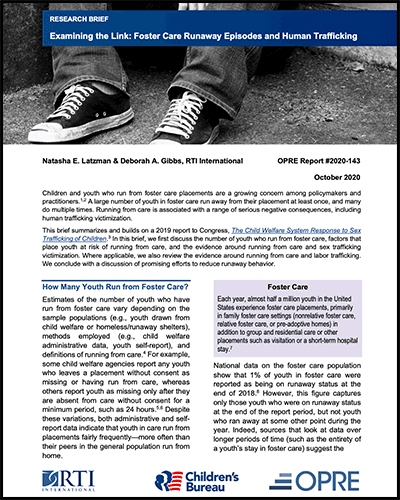
Examining the link: Foster care runaway episodes and human trafficking

Children and youth who run from foster care placements are a growing concern among policymakers and practitioners. A large number of youth in foster care run away from their placement at least once, and many do multiple times. Running from care is associated with a range of serious negative consequences, including human trafficking victimization. In this brief, we first discuss the number of youth who run from foster care, factors that place youth at risk of running from care, and the evidence around running from care and sex trafficking victimization. Where applicable, we also review the evidence around running from care and labor trafficking. We conclude with a discussion of promising efforts to reduce runaway behavior.

READ THE REPORT

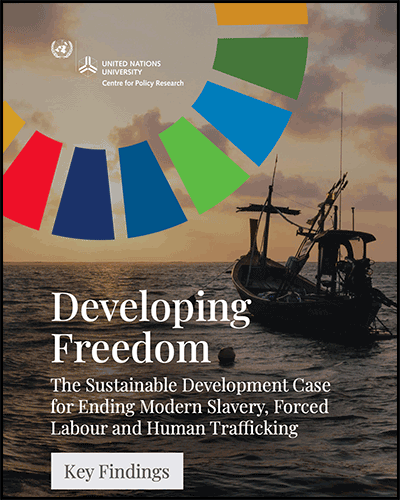
Developing Freedom: The Sustainable Development Case for Ending Modern Slavery, Forced Labour and Human Trafficking: SYNOPSIS

40.3 million people – around 1 in every 185 people alive – experienced modern slavery or forced labour in 2016. Ending modern slavery is central to several targets of the UN Sustainable Development Goals (SDGs), notably Target 8.7. Yet, development sector voices are often notable for their absence from global anti-slavery and anti-trafficking discussions. This study considers a simple question: how can fighting slavery contribute to sustainable development? Over eighteen months, we used comprehensive literature reviews and mapping, quantitative analysis, surveys and mixed methods case studies.

READ THE REPORT

Developing Freedom: The Sustainable Development Case for Ending Modern Slavery, Forced Labour and Human Trafficking: KEY FINDINGS

There were an estimated 40.3 million people in modern slavery in 2016 – 1 in every 185 people. Modern slavery involves some people treating others as if they own them. This involves intentional denial or restriction of victims’ economic agency, even as survivors assert agency in other ways. When one person enslaves another, they prevent them exercising outside labour options, and may control consumption, savings and investment choices. This control can be used to extract a rent, by coercing the victim to work below market wage. Sustainable development and human development have focused on developing people’s capabilities but have assumed people control their own economic agency. That is not always so. Addressing slavery requires a different way of thinking, that seeks to protect and maximize agency.

READ THE REPORT

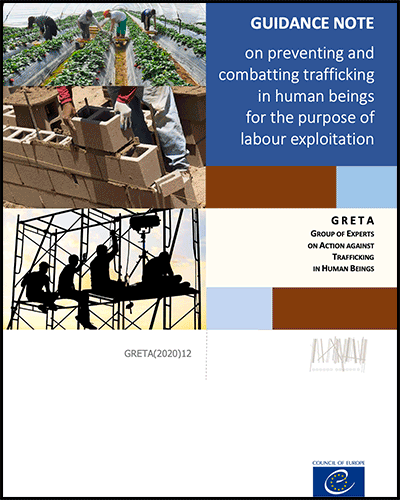
GUIDANCE NOTE on preventing and combatting trafficking in human beings for the purpose of labour exploitation

At its 35th meeting in July 2019, GRETA decided to set up an ad hoc working group on strength- ening action to combat trafficking for the purpose of labour exploitation, which drafted a compendium of good practices in the area of combating trafficking in human beings for the purpose of labour exploitation. On the basis of the compendium, GRETA has adopted this Guidance Note to further strengthen the implementation of the obligation to take measures to prevent and combat trafficking for the purpose of labour exploitation.

READ THE REPORT

Australia’s National Action Plan to Combat Modern Slavery 2020–25

The National Action Plan sets the strategic direction of our work to combat modern slavery in Australia over the next five years. Modern slavery is a devastating crime that exploits the most vulnerable in our communities. It is a crime that sees women, men and children deprived of their freedom and robbed of their rights. Modern slavery also taints the global supply chains of the goods and services we purchase everyday. The United Nations estimates that over 40 million people are trapped in modern slavery, including 16 million in private sector supply chains. Australia is not immune. There were an estimated 1,900 victims and survivors of modern slavery between 2015 and 2017 alone, with 83 per cent being women and girls. Modern slavery has no place in our society. This is why we have been relentless in our opposition to these grave violations of human rights through implementing a strong program of initiatives to combat modern slavery in Australia and abroad.

READ THE REPORT

Hidden in Plain Sight: An inquiry into Establishing a Modern Slavery Act in Australia

Modern slavery is often ‘hidden in plain sight’. These heinous crimes are present across a range of industries in Australia and in the global supply chains of businesses and organisations operating here. Latest estimates suggest that over 40 million people around the world, and 4 300 in Australia, are victims of some form of modern slavery, which includes human trafficking, slavery, debt bondage, forced labour and other slavery-like practices.

READ THE REPORT

Independent Anti-Slavery Commissioner Annual Report 2019-2020

From Dame Sara Thornton – Independent Anti-Slavery Commissioner: The Modern Slavery Act (2015) sets out my role to encourage good practice across the UK and in my strategic plan which was laid before parliament in October 2019 I set out how I planned to do that. This report is structured around the four priorities in the strategic plan and details my activities, and those of my small team, over eleven months from my appointment in May 2019.

READ THE REPORT

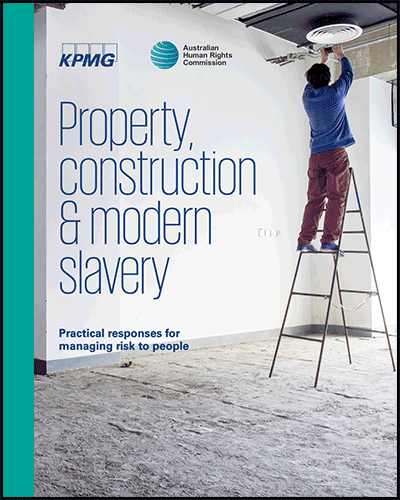
Property, Construction & Modern Slavery: Practical responses for managing risk to people

A practical guide to: highlight particular modern slavery risks prevalent in the property and construction sector; provide tips for the property and construction sector on leading practice and a rights-based approach to managing modern slavery risk; and, foster transparent modern slavery reporting for the benefit of business, government and the people at risk of harm.

READ THE REPORT

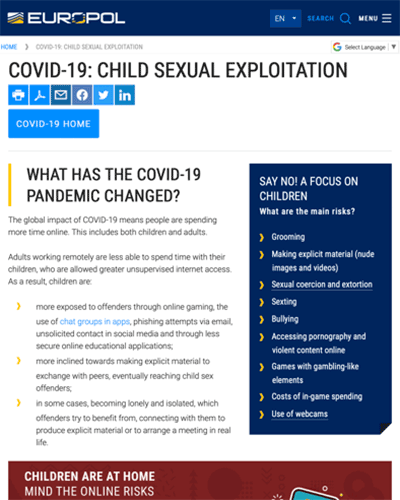
COVID-19: CHILD SEXUAL EXPLOITATION

The global impact of COVID-19 means people are spending more time online. This includes both children and adults. Adults working remotely are less able to spend time with their children, who are allowed greater unsupervised internet access. As a result, children are: more exposed to offenders through online gaming, the use of chat groups in apps, phishing attempts via email, unsolicited contact in social media and through less secure online educational applications; more inclined towards making explicit material to exchange with peers, eventually reaching child sex offenders; in some cases, becoming lonely and isolated, which offenders try to benefit from, connecting with them to produce explicit material or to arrange a meeting in real life.

READ THE REPORT

A typology of child trafficking in Albania

This report aims to better understand how Albania’s child protection system works as it relates to potential victims of child trafficking. It is based on the detailed data from 45 cases reported by the Child Protection Units from eleven municipalities across Albania. The cases were selected from those collected by the State Agency for the Rights and Protection of the Child in the framework of the support provided by the OSCE Presence in Albania because they demonstrate strong evidence of child trafficking.

READ THE REPORT

Implementing the Modern Slavery Act 2018: The Australian Government’s Annual Report

Modern slavery is an abhorrent crime that violates the personal freedom and dignity of vulnerable people around the world. Tragically, many victims of modern slavery are exploited in the supply chains of the goods and services we use every day. The United Nations estimates that over 40 million people are trapped in modern slavery and 16 million people are exploited in private sector supply chains. Australia is not immune from modern slavery. The Australian Institute of Criminology estimates that between 2015 and 2017 there were up to 1,900 victims of modern slavery in Australia.

READ THE REPORT

European Migrant Smuggling Centre: 4th Annual Report

Early in 2020, the European Union’s (EU) Member States and partner countries in and outside the Schengen Area were struck by the COVID-19 pandemic. This crisis will have a lasting impact on our societies and economies. The same is true for the organised crime environment where not only cybercrime, fraud and organised property crime is thriving in the wake of this crisis, but the dynamics of migrant smuggling and human trafficking are changing too. To counter this threat, we have to use the great advantage of shared intelligence to target these types of international organised crime and Europol plays a key role.

DOWNLOAD THE REPORT

Child trafficking and child protection: Ensuring that Child Protection Mechanisms Protect the Rights and Meet the Needs of Child Victims of Human Trafficking

In light of the heightened vulnerability of children, combating trafficking in children has been at the forefront of the OSCE’s anti-trafficking agenda for many years. Since the adoption of the 2003 OSCE Action Plan to Combat Trafficking in Human Beings and its subsequent Addendum on Addressing the Special Needs of Child Victims of Trafficking for Protection and Assistance, there has been notable progress in delivering adequate and effective responses to trafficking in children in the OSCE area. However, anti-trafficking stakeholders continue to face substantial challenges to the practical implementation of their national laws and policies. A full alignment with the OSCE anti-trafficking commitments, in particular related to children, remains to be achieved.

READ THE REPORT

The Critical Role of Civil Society in Combating Trafficking in Human Beings

The purpose of this Occasional Paper is to outline and analyse the role played by civil society in efforts to address the threat posed by the crime of human trafficking. This paper is an additional tool to assist the OSCE participating States in strengthening their response to trafficking in human beings, especially in the area of partnerships as a fundamental component of an effective anti-trafficking response.

READ THE REPORT

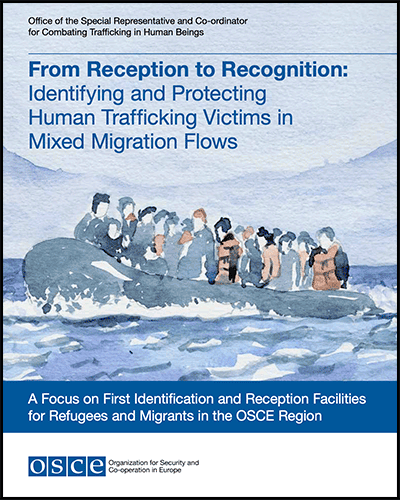
From Reception to Recognition: Identifying and Protecting Human Trafficking Victims in Mixed Migration Flows

The prolonged instability in the Middle-East, Sahel and North Africa has given rise to exceptional movements of migrants and refugees. Large mixed migratory flows have considerably affected receiving OSCE participating States, in particular countries along the Mediterranean and Balkan routes, making this essentially a European emergency. It is becoming increasingly evident that the current migration and refugee crisis creates a perfect market for the exploitation of migrants within transit and p destination countries by unscrupulous criminal syndi- cates and lone perpetrators.

READ THE REPORT

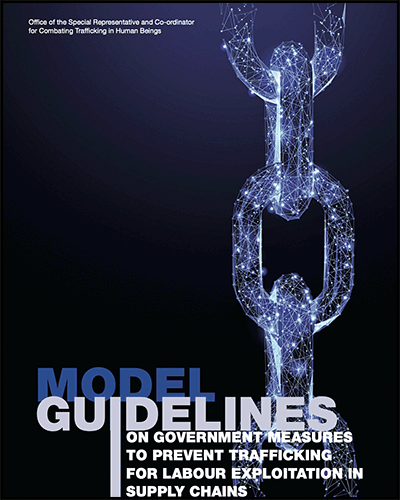
Model Guidelines on Government Measures to Prevent Trafficking for Labour Exploitation in Supply Chains

The aim of these model guidelines is to provide a practical tool to assist OSCE participating States and Partners for Cooperation to implement concrete measures to prevent trafficking in human beings in supply chains. It highlights how States can implement legislation and policies that promote transparency to ensure that public supply chains are free from trafficked labour; and promote the fair and ethical recruitment of workers.

READ THE REPORT