Compendium of relevant reference materials and resources on ethical sourcing and prevention of trafficking in human beings for labour exploitation in supply chains

The Compendium of Resources is divided into three sections. The first chapter includes State initiatives, such as laws, policies, national action plans, and guidelines developed by national authorities to address forced labour and human trafficking in supply chains. The second chapter looks at the work of NGOs, civil society, academia and the private sector regarding ethical sourcing and exploitation in supply chains. Finally, the third chapter reflects relevant initiatives of international organizations, including international treaties, political commitments, reports, publications, and others.
READ THE REPORT

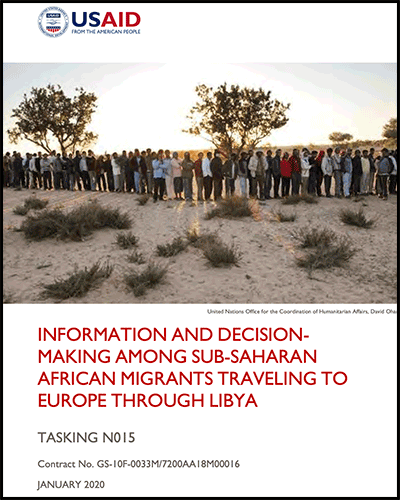
Information and Decision-Making Among Sub-Saharan Migrants Traveling to Europe through Libya

Arrivals to Europe from Africa, especially across the central Mediterranean route from Libya and Tunisia to Italy, have fallen since mid-2017. Most observers believe that European Union (EU) migration policies, particularly EU and Libyan interdiction measures as well as agreements between the EU and various governments, are responsible for the falling numbers of arrivals. Yet EU officials and many experts also believe that the underlying drivers of migration, including migrants’ hopes for better lives in Europe and/or migrants’ desires to flee oppressive regimes and conflict zones, are still firmly in place.

READ THE REPORT

Modern Slavery Act 2018 and associated matters

The task of this inquiry was to examine the New South Wales Modern Slavery Act 2018, which was passed by the NSW Parliament on 21 June 2018 and has yet to be proclaimed. The committee was also tasked with examining consultation drafts prepared by the NSW Government of the Modern Slavery Amendment Bill 2019 and Modern Slavery Regulation 2019. The committee expresses its support for the NSW Act, based on the evidence in this inquiry as to its many world-leading features. These include a robust supply chain transparency scheme for both business and government, an Anti-Slavery Commissioner, the creation of new modern slavery offences, support for victims and the establishment of a parliamentary committee to provide oversight of this important policy area.

READ THE REPORT

Endline research findings on fishers and seafood workers in Thailand

This endline survey shows the accomplishment of the integration between the public sector, employers, workers, and civil society, with a mutual ambition to prevent and eliminate trafficking in persons, child labour, forced labour, and unacceptable forms of work in Thailand’s fishing and seafood processing industries. Some of Thailand’s achievements have been revealed in the reports, such as the increasing of regular labour migration, lower costs for migration and higher wages. However, there are still gaps and challenges, and every partner in Thailand and neighbouring countries needs to work together to encourage fair and sustainable seafood industries along the global supply chains.

READ THE REPORT

Department of Homeland Security Strategy to Combat Human Trafficking, the Importation of Goods Produced With Forced Labor, and Child Sexual Exploitation

The United States has declared it a national priority to end human trafficking, the importation of goods produced with forced labor, and child sexual exploitation. The U.S. Department of Homeland Security is on the frontlines of this fight, protecting the country and collaborating with our partners to stop these crimes. To leverage all of our authorities in this fight, DHS developed a first-of-its-kind Strategy to Combat Human Trafficking, the Importation of Goods Produced with Forced Labor, and Child Sexual Exploitation. It represents our vision to end this urgent humanitarian issue, articulates the Department’s long-term approach for combating these crimes, and serves as a framework to prioritize our resources and monitor progress.

READ THE REPORT

Report of the OSCE Special Representative and Co-ordinator for Combating Trafficking in Human Beings: New Challenges and New Opportunities

The Office of the Special Representative and Co-ordinator for Combating Trafficking in Human Beings (OSR/CTHB) confronts human trafficking concretely and comprehen- sively, paying particular attention to its cross-dimensional nature and the OSCE’s focus on the intersection of secu- rity and human rights. Trafficking in human beings is not only a human rights violation but also a grave security concern. It generates cross-border and internal instability when the rule of law and human security are undermined through the exploitation of vulnerable people. Security and human rights in the OSCE region are threatened as long as the scourge of human trafficking persists.

READ THE REPORT

Review of Models of Care for Trafficking Survivors in Thailand

This report summarizes the findings of a Review of Models of Care for Trafficking Survivors that was completed by Winrock International (Winrock) in 2018-2019 under the United States Agency for International Development’s Thailand Counter Trafficking-in-Persons project. The research aimed to compare models of care available to trafficked persons (men, women, girls and boys, and lesbian, gay, bisexual, transgender, queer, and intersex [LGBTQI] people) in Thailand, and assess their relative effectiveness in victim recovery. The study also explored models used elsewhere that could be adapted to the Thailand context.

READ THE REPORT

Stolen freedom: the policing response to modern slavery and human trafficking

In the UK, today and every day, thousands of men, women and children who are victims of modern slavery and human trafficking are being degraded and dehumanised. These crimes are multi-faceted. Cases may involve single or multiple offenders or victims, and may be national or international, organised or opportunistic. They occur in both rural and metropolitan areas, in settings ranging from nail bars to construction sites, and involve activities from domestic servitude to the trafficking of children for sexual exploitation. It is imperative that police forces are aware of the signs and indicators of these most pernicious and frequently hidden of crimes so that they can respond in an appropriate manner.

READ THE REPORT

Service Recommendations for Human Trafficking Survivors With Substance Use Disorders

This document was developed by fellows of the 2018 Human Trafficking Leadership Academy (HTLA) organized through the National Human Trafficking Training and Technical Assistance Center (NHTTAC) and Coro Northern California. A team of six non-government service providers and six survivor leaders worked together to develop recommendations on how to enhance service provision to survivors of human trafficking or those at risk of human trafficking using trauma-informed practices and survivor-informed principles.

READ THE REPORT

Strengthening Protections Against Trafficking in Persons in Federal and Corporate Supply Chains

The EO requires prime contractors providing large overseas contracts to develop and maintain detailed anti-trafficking compliance programs and provide annual certification of their anti- trafficking efforts.

To assist United States Government agencies and the federal contracting community to prepare for implementation of the EO and new FAR rules, the United States Department of State’s Office to Monitor and Combat Trafficking in Persons (DOS/J/TIP) asked Verité to investigate and map out the risk of trafficking in global supply chains generally, and in federal supply chains in particular.

READ THE REPORT

2014 Report to the Texas Legislature Human Trafficking Prevention Task Force

In conjunction with dedicated members of the Texas Legislature, the Task Force has helped Texas become and remain a leader in anti-trafficking efforts. Shared Hope International, a leading anti-trafficking organization, awarded Texas some of the highest rankings in the nation in 2013 and 2014 in its annual Protected Innocence Challenge. Texas received perfect scores for its efforts to criminalize domestic minor sex trafficking and provide criminal justice tools for investigation and prosecution of trafficking cases. Additionally, the state received near perfect scores for its work related to criminal provisions addressing demand and criminal provisions for traffickers.

READ THE REPORT

Manual for Experts on Multidisciplinary Cooperation Against Trafficking in Human Beings for Labour Exploitation

Aimed at experts and intended to help inspire and strengthen the policy and practice to address trafficking in human beings (THB) for labour exploitation of all organisations that could come across it. More specifically, it aims to stimulate multidisciplinary and cross-border cooperation and a comprehensive approach against this phenomenon. Expertise and ideas from experts from all Member States were collected as input for the manual. It contains knowledge and expertise on THB for labour exploitation from all over the European Union.

READ THE REPORT

Trafficking in Human Beings for the Purpose of Organ Removal – A Comprehensive Literature Review

Trafficking in human beings for the purpose of organ removal (THBOR) is prohibited worldwide, yet a growing number of reports indicate its increase across the globe. Many countries in and outside the European Union (EU) have implemented proper legislation against THBOR. However, information regarding the incidence of THBOR and the non-legislative response to it is practically non-existent and unavailable to judicial and law enforcement authorities in the EU member states. Transplant professionals, human rights NGOs and international organizations also have little knowledge and awareness of the crime. This knowledge gap hampers the development of a structured and effective action to this repugnant form of human trafficking, which brings physical and psychological harms to vulnerable individuals. This report’s objective is to gather information and increase knowledge about THBOR. It does so by describing the state-of-the-art of literature on the ethical aspects, causes and the actors involved in THBOR.

READ THE REPORT

Trafficking in Human Beings

Includes statistical data from all 28 EU Member States and the following EU Candidate and EFTA/EEA (Iceland, Norway) countries: Montenegro, Norway, Serbia, Switzerland and Turkey. This is a working paper looking at statistical data at EU level as gathered and submitted by national authorities. In this respect, it is a unique undertaking in this field at EU level. The data have been collected from official sources, and provide information on registered victims, suspects, prosecutions and convictions, as recorded by the authorities.

READ THE REPORT

U.S. Department of State Trafficking in Persons (TIP) Report 2014

In addition to assessments of what almost every government in the world is doing to combat modern slavery, this year’s Trafficking in Persons Report takes a hard look at the journey from victim to survivor, making recommendations and highlighting effective practices that, if implemented, could ease the path forward for countless survivors around the world.

To make it easier to download, 2014’s TIP was broken up into sections.

The Geography of Trafficking in Tennessee 2013

Follow-up Report to the Tennessee Human Sex Trafficking and Its Impact on Children and Youth 2011. Profiles minor sex trafficking cases of Tennessee counties and provides statistical comparisons between cases reported from law enforcement and non-law enforcement responders. Additionally, this study analyzes data in counties that reported the highest numbers of minor sex trafficking. As of July 2013, twelve new anti-human trafficking laws have been created to address this epidemic. Domestic issues, the drug trade, poverty and other socio-economic factors serve as catalysts for human sex trafficking.

READ THE REPORT

Human Trafficking in North Carolina: Human Beings as a Commodity

Research has documented that human trafficking is a growing problem in this country (Richard, 1999). In fact the United States is listed as one of the leading destinations in the world for traffickers (Hepburn & Simon, 2010). The North Carolina Coalition Against Human Trafficking (NCCAHT) (2013) Web site notes that North Carolina ranks in the top eight states in the country for factors conducive to trafficking in persons. These factors include the state’s strategic location on the Eastern seaboard, the number of major interstate highways traversing the state, the large agricultural economy, the number of military installations and the number of ports located in the coastal region. These conditions make North Carolina a prime target for traffickers, whether the commodity is drugs, weapons or human beings (NCCAHT, 2013).

READ THE REPORT

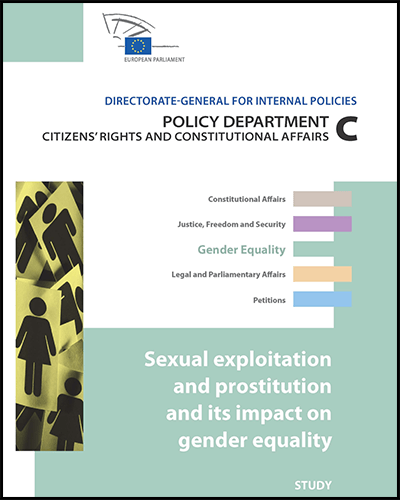
Sexual Exploitation and Prostitution and Its Impact on Gender Equality

Provides background information drawn from the international literature on sexual exploitation and prostitution and its impact on gender equality in relation to the report of the Women’s Rights and Gender Equality Committee. The study concentrates on the debate on whether prostitution could be voluntary or has rather to be regarded in any case as a violation of women’s human rights. It also presents an overview of the policies on prostitution in the Member States as well as four case studies: Germany, the Netherlands, Spain, and Sweden. Conclusions are presented with the view to enhance the debate.

READ THE REPORT