The Geography of Trafficking in Tennessee 2013

Follow-up Report to the Tennessee Human Sex Trafficking and Its Impact on Children and Youth 2011. Profiles minor sex trafficking cases of Tennessee counties and provides statistical comparisons between cases reported from law enforcement and non-law enforcement responders. Additionally, this study analyzes data in counties that reported the highest numbers of minor sex trafficking. As of July 2013, twelve new anti-human trafficking laws have been created to address this epidemic. Domestic issues, the drug trade, poverty and other socio-economic factors serve as catalysts for human sex trafficking.

READ THE REPORT

Human Trafficking in North Carolina: Human Beings as a Commodity

Research has documented that human trafficking is a growing problem in this country (Richard, 1999). In fact the United States is listed as one of the leading destinations in the world for traffickers (Hepburn & Simon, 2010). The North Carolina Coalition Against Human Trafficking (NCCAHT) (2013) Web site notes that North Carolina ranks in the top eight states in the country for factors conducive to trafficking in persons. These factors include the state’s strategic location on the Eastern seaboard, the number of major interstate highways traversing the state, the large agricultural economy, the number of military installations and the number of ports located in the coastal region. These conditions make North Carolina a prime target for traffickers, whether the commodity is drugs, weapons or human beings (NCCAHT, 2013).

READ THE REPORT

Slavery at Sea: The Continued Plight of Trafficked Migrants in Thailand’s Fishing Industry

Provides recent examples of problems that have long plagued the industry in Thailand. Since the late 1980s, Thailand’s increasing prosperity and low unemployment rate have led many Thai citizens to turn away from low-paid work in the country’s more labour-intensive sectors, including construction, fishing and seafood processing. At the same time, Thailand’s comparatively underdeveloped neighbours have provided a cheap and plentiful supply of migrant labour, which has acted to discourage businesses from investing in labour-saving production processes.22 Consequently, entire sections of the Thai economy have become strongly reliant on migrant labour. Workers from Myanmar, Laos and Cambodia now constitute up to 10 per cent of Thailand’s workforce, and as much as 90 per cent in the seafood industry.

READ THE REPORT

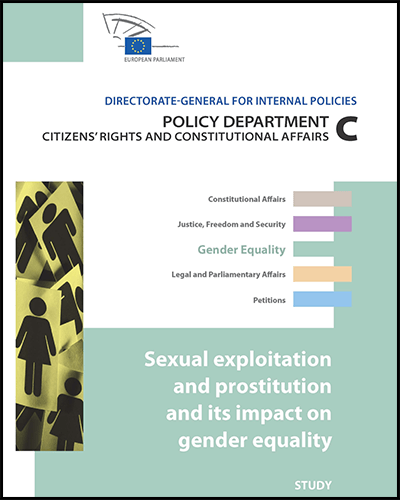
Sexual Exploitation and Prostitution and Its Impact on Gender Equality

Provides background information drawn from the international literature on sexual exploitation and prostitution and its impact on gender equality in relation to the report of the Women’s Rights and Gender Equality Committee. The study concentrates on the debate on whether prostitution could be voluntary or has rather to be regarded in any case as a violation of women’s human rights. It also presents an overview of the policies on prostitution in the Member States as well as four case studies: Germany, the Netherlands, Spain, and Sweden. Conclusions are presented with the view to enhance the debate.

READ THE REPORT