U.S. Department of State Trafficking in Persons (TIP) Report 2019

This year, the TIP Report introduction highlights human trafficking that takes place exclusively within the borders of one country, absent any transnational elements. Although acknowledging human trafficking in this form is not new or novel, it remains important. The ILO reports that, globally, traffickers exploit 77 percent of victims in their countries of residence. Far too often, individuals, organizations, and governments erroneously use definitions of trafficking in persons that require the movement of victims.

READ THE REPORT

Beyond Voluntarism: Human rights and the developing international legal obligations of companies

Interest is growing in the responsibility of private companies to respect human rights. What was once a marginal issue is now a major concern of companies, as well as governments, intergovernmental and non- governmental organisations, investors and consumers. In July 2000 the UN Secretary-General, Kofi Annan, launched the Global Compact, a UN- sponsored appeal which called on companies to commit themselves to respect nine core principles in relation to human rights, labour and the environment. Hundreds of companies, including many of the world’s largest, have joined this initiative.

READ THE REPORT

Labor and Sex Trafficking Among Homeless Youth

Human trafficking—the exploitation of a person’s labor through force, fraud, or coercion—is a crime whose victims tend to be society’s most vulnerable. People who are homeless, lack a support system, or are desperate for work are susceptible to the promises of people who would exploit them for labor and for sex. Recently, homeless youth providers in the United States and Canada have become aware that their clients are particularly at risk of trafficking and research has begun to uncover the extent and contours of the problem within that community.

READ THE REPORT

The Impact of COVID-19 on Research with Sex Trafficked Women and Women Engaged in Commercial Sex Activities: Implications for Funding, Outreach and Engagement

In response to the Coronavirus (COVID-19) outbreak, many forms of communications have moved to Zoom, Skype, social media outlets, and a number of other online platforms. Research through these mediums, however, poses a unique set of challenges when the population involves sex trafficked populations and those who engage in commercial sex. Sex trafficking involves the recruitment, harboring, transportation, provision, or obtaining of a person for the purpose of a commercial sex act (Public Law No. 106-386), while commercial sex activities refer to the selling or exchanging of sex for some material good (e.g., money, drugs, housing, etc.). These two populations may be fluid and not necessarily always independent of one another.

Coalition to Abolish Slavery & Trafficking (CAST)

Established in 1998 in the wake of the El Monte sweatshop case where 72 Thai garment workers were kept for eight years in slavery and debt bondage. Upon their release and under the leadership of CAST’s founder Dr. Kathryn MacMahon, a group of concerned community activists realized something needed to be done to address the re-emergence of slavery in our own backyards.

U.S. Department of State Trafficking in Persons (TIP) Report 2020

For 20 years, the Trafficking in Persons Report (TIP Report) has demonstrated the United States’ conviction that human trafficking is a global threat necessitating a global response. Traffickers are denying nearly 25 million people their fundamental right to freedom, forcing them to live enslaved and toil for their exploiter’s profit. This report arms governments with the data they need to increase the prosecution of traffickers, provide victim-centered and trauma-informed protection for victims of trafficking, and prevent this crime altogether.

READ THE REPORT

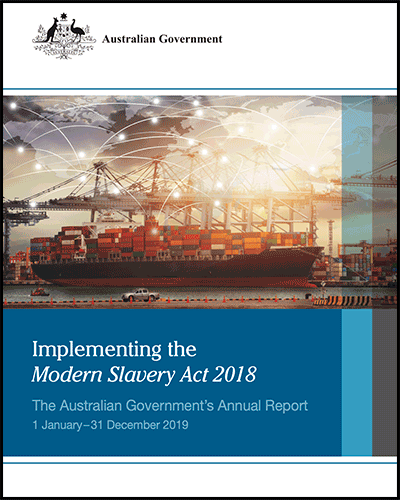
Implementing the Modern Slavery Act 2018: The Australian Government’s Annual Report

Modern slavery is an abhorrent crime that violates the personal freedom and dignity of vulnerable people around the world. Tragically, many victims of modern slavery are exploited in the supply chains of the goods and services we use every day. The United Nations estimates that over 40 million people are trapped in modern slavery and 16 million people are exploited in private sector supply chains. Australia is not immune from modern slavery. The Australian Institute of Criminology estimates that between 2015 and 2017 there were up to 1,900 victims of modern slavery in Australia.

READ THE REPORT

Truckers Against Trafficking

Truckers Against Trafficking recognizes that members of the trucking industry and individual truckers are invaluable in the fight against this heinous crime. As the eyes and ears of our nation’s highways, truckers are in a unique position to make a difference and close loopholes to traffickers who seek to exploit the transportation system for their personal gain. This site has been created to inform truckers and other travelers of the basic issues involved in human trafficking and a summary of ways they can help.

COVID-19 Position paper: The impact and consequences of the COVID-19 pandemic on trafficked and exploited persons

The policies and measures adopted in the wake of the pandemic will be crucial in the unfolding crisis and will also shape how the labour market and, in general, societies will look like into the future. This paper aims at analyzing how the socio-economic consequences of the pandemic will exacerbate the vulnerabilities to trafficking, posing a further threat not only to actual victims, but also to people at risk of being trafficked.

READ THE REPORT

Maiti Nepal

MAITI Nepal was born out of a crusade to protect Nepali girls and women from crimes like domestic violence, trafficking for flesh trade, child prostitution, child labor and various forms of exploitation and torture. A group of socially committed professionals like teachers, journalists and social workers together formed Maiti Nepal in 1993 to fight against all the social evils inflicted upon our female populace. Most of all, its special focus has always been on preventing trafficking for forced prostitution, rescuing flesh trade victims and rehabilitating them.

Lebanon: Domestic Workers in the Shadow of Kafala System and COVID-19

We look at the conclusions to be drawn from the International Development Law Organization’s (IDLO) recent research into the criminal justice response to human trafficking in Kyrgyzstan, a landlocked country in the heart of Central Asia, and consider how a new initiative could help to tackle some of the barriers to effective prosecution of traffickers identified in this research.

International Justice Mission

International Justice Mission is a human rights agency that brings rescue to victims of slavery, sexual exploitation and other forms of violent oppression. IJM lawyers, investigators and aftercare professionals work with local officials to secure immediate victim rescue and aftercare, to prosecute perpetrators and to ensure that public justice systems – police, courts and laws – effectively protect the poor.

Child Labour and Coronavirus in Bangladesh: How do we respond to the shattered livelihoods?

We look at the conclusions to be drawn from the International Development Law Organization’s (IDLO) recent research into the criminal justice response to human trafficking in Kyrgyzstan, a landlocked country in the heart of Central Asia, and consider how a new initiative could help to tackle some of the barriers to effective prosecution of traffickers identified in this research.