Human Trafficking and Risky Migration Routes Data Collection: A Case Study From Kenya

In August, 2019, Stop the Traffik Kenya (STTK) and Freedom Collaborative (FC), a project operated by Liberty Shared, launched a data collection effort with civil society organisations (CSOs) in Kenya to report known human trafficking and high-risk migration routes based on their work with survivors and at-risk populations. Data was gathered from partners over the course of one month to demonstrate how much knowledge can be made available when each organisation is sharing their individual data.

READ THE REPORT

World Migration Report 2020

IOM’s responsibility to provide an objective and balanced account of migration globally has never been more important. Not only is the political salience of migration high, and frequently fevered, but the capacity for rapidly disseminating disinformation to influence the public discourse has expanded. Twenty years ago, IOM published the first World Migration Report with the stated aim of providing an authoritative account of migration trends and issues worldwide. With the initial report published in 2000, the series has quickly become established as IOM’s flagship publication. The early World Migration Reports were framed around specific themes. They provided deep dives into topics such as labour mobility, migrant well-being and communication on migration. But, with time, there was a sense that the broader landscape and complexity of migration issues was being neglected.

READ THE REPORT

Trading Women (Preview, 7:24)

Directed by David A. Feingold and produced by Dean Slotar and David A. Feingold for Ophidian Films. Narrated by Angelina Jolie, Trading Women enters the worlds of brothel owners, trafficked girls, voluntary sex workers, corrupt police and anxious politicians. Filmed in Burma, China, Laos, and Thailand, this is the first film to follow the trade in women in all its complexity and to consider the impact of this ‘far away’ problem on the global community.

OFFICIAL SITE

NON-PUNISHMENT OF VICTIMS OF TRAFFICKING

Las infracciones de los derechos humanos son a la vez causa y consecuencia de la trata de personas. Por lo tanto, es indispensable que la protección de todos los derechos humanos ocupe un lugar central en las medidas que se adopten para prevenir esa trata y ponerle término. Las medidas para combatir la trata de personas no deben redundar en desmedro de sus derechos humanos y su dignidad y, en particular, de los derechos de quienes han sido víctimas de ella, los migrantes, las personas desplazadas internamente, los refugiados y quienes soliciten asilo.

READ THE REPORT

CONFRONTING THE GLOBAL FORCED MIGRATION CRISIS

The size and scope of the global forced migration crisis are unprecedented. Almost 66 million people worldwide have been forced from home by conflict. If recent trends continue, this figure could increase to between 180 and 320 million people by 2030. This global crisis already poses serious challenges to economic growth and risks to stability and national security, as well as an enormous human toll affecting tens of millions of people. These issues are on track to get worse; without significant course correction soon, the forced migra- tion issues confronted today will seem sim- ple decades from now.

READ THE REPORT

Half the Sky: Turning Oppression into Opportunity for Women (Trailer, 5:47)

Lend your voice to push for stronger legislation targeting sex trafficking and supporting victims, and learn more about the organizations working to end this terrible injustice. Half the Sky is raising awareness to help bring an end to sex trafficking and forced prostitution. At no point in history have more people been enslaved than there are women currently in the sex trade. The exploitation of mostly women and girls forced into prostitution generates an estimated $27.8 billion each year, making it one of the fastest growing organized crime.

OFFICIAL SITE

Responding to the Human Trafficking–Migrant Smuggling Nexus

Probably nowhere more than in Libya have the definitional lines between migrant smuggling and human trafficking become as blurred or contested. Hundreds of thousands of migrants have left Libya’s shores in the hope of a new life in Europe; tens of thousands have died in the process. The inhumane conditions migrants face in Libya are well documented. The levels of brutality and exploitation they experience in Libya’s turbulent transitional environment have led to smuggling and trafficking groups being bundled under one catch-all heading by authorities and policymakers, and targeted as the root cause of the migration phenomenon. In many respects, this would appear to conveniently serve the interests of EU leaders and governments, who choose to disguise the anti-migration drive they urgently seek support for behind a policy of cracking down on both trafficking and smuggling rings, which they conflate as a common enemy, and one and the same. Given the highly complex context of Libya, this report proposes instead that any intervention to address the so-called migrant crisis should place the human rights of migrants at its centre, as opposed to necessarily demonizing smugglers, who are often the migrants’ gatekeepers to a better existence elsewhere.

READ THE REPORT

Very Young Girls (Trailer, 1:50)

Showtime Networks Presents VERY YOUNG GIRLS, Produced and Directed by David Schisgall.

Very Young Girls is an exposé of the commercial sexual exploitation of girls in New York City as they are sold on the streets by pimps and treated as adult criminals by police. The film follows barely adolescent girls in real time, using vérité and intimate interviews with them, documenting their struggles and triumphs as they seek to exit the commercial sex industry. The film also uses startling footage shot by pimps themselves, giving a rare glimpse into how the cycle of exploitation begins for many women.

OFFICIAL SITE

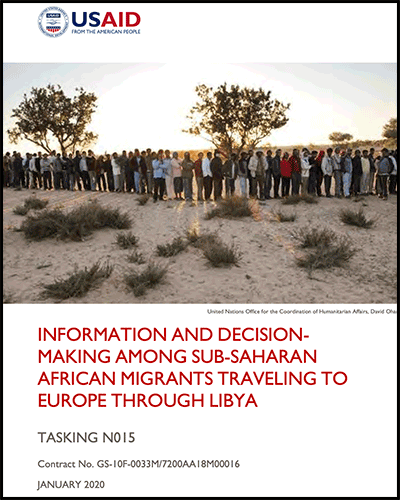
Information and Decision-Making Among Sub-Saharan Migrants Traveling to Europe through Libya

Arrivals to Europe from Africa, especially across the central Mediterranean route from Libya and Tunisia to Italy, have fallen since mid-2017. Most observers believe that European Union (EU) migration policies, particularly EU and Libyan interdiction measures as well as agreements between the EU and various governments, are responsible for the falling numbers of arrivals. Yet EU officials and many experts also believe that the underlying drivers of migration, including migrants’ hopes for better lives in Europe and/or migrants’ desires to flee oppressive regimes and conflict zones, are still firmly in place.

READ THE REPORT

Los Derechos Humanos y la Trata de Personas

Las infracciones de los derechos humanos son a la vez causa y consecuencia de la trata de personas. Por lo tanto, es indispensable que la protección de todos los derechos humanos ocupe un lugar central en las medidas que se adopten para prevenir esa trata y ponerle término. Las medidas para combatir la trata de personas no deben redundar en desmedro de sus derechos humanos y su dignidad y, en particular, de los derechos de quienes han sido víctimas de ella, los migrantes, las personas desplazadas internamente, los refugiados y quienes soliciten asilo.

READ THE REPORT

Human Rights and Human Trafficking

This Fact Sheet seeks to provide a brief but comprehensive overview of human rights and human trafficking. In exploring the applicable legal and policy framework, it draws on two major outputs of the Office of the United Nations High Commissioner for Human Rights (OHCHR): the 2002 Recommended Principles and Guidelines on Human Rights and Human Trafficking and its extensive Commentary.

READ THE REPORT

Abolishing Slavery and its Contemporary Forms

The definition of slavery has caused controversy since the beginning of the abolition process, yet is of paramount importance for the international community in working towards its effective eradication. Definitions have caused controversy for two reasons: first, there are differences of opinion about which practices should be categorized as slavery and thus designated for elimina- tion; second, definitions have often been accompanied by obligations on States to carry out particular remedial measures. There has invariably been disagreement about the most appropriate strategies to eradicate any form of slavery.

READ THE REPORT

Human Trafficking 101 (15:24)

This video outlines what is human trafficking in clear, basic easy to understand format. The video is broken up into 4 sections, 1. Outlining the problem, 2. The criminal element, 3. Addressing the exploitation, 4.Understanding the post exploitation process. The video explains the process of how and why a person can become a victim of human trafficking.

OFFICIAL SITE

Recommended Principles and Guidelines on Human Rights and Human Trafficking

The Recommended Principles and Guidelines on Human Rights and Human Trafficking, which are included as an addendum to my report to the Economic and Social Council (E/2002/68/Add.1), have been developed in order to provide practical, rights-based policy guidance on the prevention of trafficking and the protection of victims of trafficking. Their purpose is to promote and facilitate the integration of a human rights perspective into national, regional and international anti-trafficking laws, policies and interventions.

READ THE REPORT