UNODC Global Report on Trafficking in Persons 2018, Booklet 2: Trafficking in Persons in the Context of Armed Conflict

In 2016, more countries were experiencing some form of violent conflict than at any other time in the previous 30 years. People living in conflict-affected areas may experience abuse, violence and exploitation, including trafficking in persons. The risk of trafficking in persons is also connected with the high numbers of refugees. A need to flee war and persecution may be taken advantage of for exploitation by traffickers.

READ THE REPORT

UNODC Global Report on Trafficking in Persons 2018

The Global Report on Trafficking in Persons 2018 puts thespotlight on human trafficking in armed conflict. Humantrafficking is always a crime, committed with the intention to exploit; in conflict situations, characterized by violence, brutality and coercion, traffickers can operate with even greater impunity. Trafficking in armed conflict has taken on horrific dimensions – child soldiers, forced labour, sexual slavery.

READ THE REPORT

Modern Slavery, Environmental Destruction and Climate Change: Fisheries, Field, Forests and Factories

Modern slavery and climate change have emerged as concurrent crises in the contemporary world. While these phenomena have been well-established separately in recent academic and policy-based debates, little discussion has taken place on the interconnections between them. An emerging area of research has begun to interrogate aspects of the nexus between modern slavery, environmental destruction and climate change, but a review of the existing literature in the area remains lacking.

READ THE REPORT

BLOOD BRICKS: Untold Stories of Modern Slavery and Climate Change from Cambodia

In Cambodia, as in many other countries, economic growth has not led to decent work for all. In fact, quite the opposite scenario has been unfolding over the past years: Poor farmers who are unable to earn a living from agriculture as a consequence of climate change move to urban and peri-urban areas and become victims of forced and of bonded labour which are contemporary forms of slavery. In this way, the economic growth which flourishes due to a booming construction industry has created in itself a trap for the poor and vulnerable. It is a vicious cycle which is enabled by development which is not sustainable. Not for the environment and not for the people who are behind it. To break this vicious and dangerous cycle, the interlinkages between contemporary forms of slavery and climate change need to be understood by the government of Cambodia in order to create viable alternatives. The present report illustrates these linkages in an eye-opening way, shedding light on a so far scarcely researched yet so essential subject.

READ THE REPORT

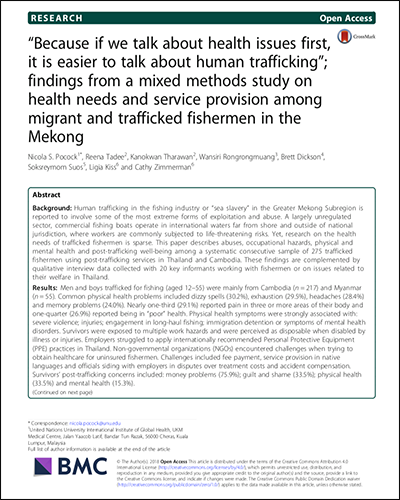
“Because if we talk about health issues first, it is easier to talk about human trafficking”; findings from a mixed methods study on health needs and service provision among migrant and trafficked fishermen in the Mekong

Human trafficking in the fishing industry or “sea slavery” in the Greater Mekong Subregion is reported to involve some of the most extreme forms of exploitation and abuse. A largely unregulated sector, commercial fishing boats operate in international waters far from shore and outside of national jurisdiction, where workers are commonly subjected to life-threatening risks. Yet, research on the health needs of trafficked fishermen is sparse.

This paper describes abuses, occupational hazards, physical and mental health and post-trafficking well-being among a systematic consecutive sample of 275 trafficked fishermen using post-trafficking services in Thailand and Cambodia. These findings are complemented by qualitative interview data collected with 20 key informants working with fishermen or on issues related to their welfare in Thailand.

READ THE REPORT

FACT SHEET: Human Trafficking and Health Care Providers

Health care providers have an important, proactive role to play in combating human trafficking in the United States. With proper training, health care providers can play a significant part in identifying and caring for trafficking victims.4 Medical personnel can also document injuries, testify as expert witnesses, and provide affidavits for submission in legal cases. But in order to be able to identify trafficking cases, health care providers must be familiar with red flags and trafficking indicators.

This fact sheet highlights medical components of case studies drawn directly from federal criminal indictments and civil trafficking complaints. These case studies provide documented incidents that illustrate how human trafficking has presented in health care settings. It is hoped that these concrete examples gleaned from legal cases will assist medical professionals in recognizing red flags and risk factors.

READ THE REPORT

“Now You Know”

Now You Know is an anti-slavery public service announcement (PSA) that addresses three forms of human trafficking: commercial sexual exploitation of both males and females, domestic servitude and forced labour in the supply chain of everyday products such as coffee. The 2-minute video was produced by film students at Hothouse Productions, Boston University College of Communication. Now You Know was devised in close collaboration with the client, The NO Project, a global anti-slavery public awareness initiative.

OFFICIAL SITE

U.S. Legal Remedies for Minor Victims of Sex Tourism and Sex Trafficking

In 2003, the United States Congress passed a law to fight sex tourism and sexual abuse of children. Congress titled the law the Prosecutorial Remedies and Other Tools to End
the Exploitation of Children Today (“PROTECT”) Act.1 Under the PROTECT Act, any U.S. citizen or legal permanent resident who sexually abuses or exploits children, anywhere in the world, can be held accountable in U.S. federal courts….

READ THE REPORT

Time to break old habits: Shifting from Complicity to Protection of the Rohingya in Myanmar

This study outlines the need for the international community in Myanmar to dramatically change gears in their approach if they are to break out of a cycle of passive complicity with ethnic cleansing and make a more lasting contribution to protecting the persecuted Rohingya Muslim minority in Myanmar. The article analyzes years of secrecy, self-censorship and silent compliance with government policies of abuse. It calls on all actors to engage in more forthright reporting and advocacy, confronting government harassment more boldly. It further urges donors and agencies to stop all support to ethnic detention centres and to strictly condition all their future contributions and programming in Myanmar – linking such support to the granting of freedom of movement and other rights to the Rohingya.

READ THE REPORT

U.S. Department of State Trafficking in Persons (TIP) Report 2018

This year’s report focuses on effective ways local communities can address human trafficking proactively and on how national governments can support and empower them. Local communities are the most affected by this abhorrent crime and are also the first line of defense against human trafficking. By engaging and training law enforcement, religious leaders, teachers, tribal elders, business executives, and communities, we become more vigilant and learn to identify and address vulnerabilities swiftly. Proactive community-driven measures strengthen our ability to protect our most vulnerable and weaken a criminal’s ability to infiltrate, recruit, and exploit.

READ THE REPORT

“Warning Signs”

This short animated film highlights the strategies that traffickers use to lure victims into slavery and the warning signs to look out for. Victims of trafficking are modern-day slaves, forced, defrauded, or coerced into various forms of labour or prostitution. It happens everyday, in countries all around the world.

OFFICIAL SITE

U.S. Department of State Trafficking in Persons (TIP) Report 2017

In particular, the introduction of this year’s Report focuses on the responsibility of governments to criminalize human trafficking and hold offenders accountable. To that end, this Report is intended to assist governments in identifying threats so law enforcement agencies around the world can respond effectively and gain insight into where human trafficking remains most severe. The Report will also equip local and sub-national law enforcement agencies to better assist in efforts to target and prosecute those who commit these terrible crimes.

READ THE REPORT

Watch video of the announcement ceremony HERE

How Footwear Companies and Luxury Brands Tackle Forced Labor Risks in Their Leather Supply Chains

This case study assesses how a sample of five footwear companies and five luxury clothing brands address forced labor risks across their leather supply chains. The study follows KnowTheChain’s first apparel and footwear benchmark which found a lack of transparency and action to address forced labor abuses beyond first-tier suppliers, particularly in leather.

READ THE REPORT