Rohingya refugees’ perspectives on their displacement in Bangladesh: Uncertain futures

While there is good understanding of the short-term needs of Rohingya refugees and their perspectives, this does not appear to be informing planning for the medium term. This paper – based on qualitative and quantitative research with Rohingya refugees in Bangladesh – provides insight into the current political and policy context, refugees’ challenges and aspirations, community engagement and what could improve refugees’ lives in the medium to long term.

READ THE REPORT

2017 Federal Human Trafficking Report

The 2017 Federal Human Trafficking Report represents a long-lasting desire to capture and analyze what federal courts in the United States are doing to combat human trafficking. The Human Trafficking Institute undertook this project with the ambitious goal of capturing an exhaustive list of all the criminal and civil human trafficking cases in the United States. Through the tireless work of the Institute’s team members, this Report contains wide-ranging information about every human trafficking case that federal courts handled during 2017.

READ THE REPORT

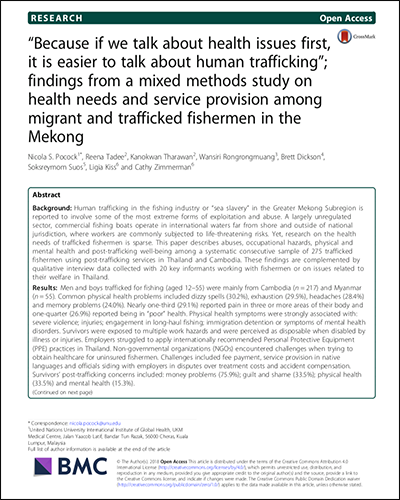
“Because if we talk about health issues first, it is easier to talk about human trafficking”; findings from a mixed methods study on health needs and service provision among migrant and trafficked fishermen in the Mekong

Human trafficking in the fishing industry or “sea slavery” in the Greater Mekong Subregion is reported to involve some of the most extreme forms of exploitation and abuse. A largely unregulated sector, commercial fishing boats operate in international waters far from shore and outside of national jurisdiction, where workers are commonly subjected to life-threatening risks. Yet, research on the health needs of trafficked fishermen is sparse.

This paper describes abuses, occupational hazards, physical and mental health and post-trafficking well-being among a systematic consecutive sample of 275 trafficked fishermen using post-trafficking services in Thailand and Cambodia. These findings are complemented by qualitative interview data collected with 20 key informants working with fishermen or on issues related to their welfare in Thailand.

READ THE REPORT

FACT SHEET: Human Trafficking and Health Care Providers

Health care providers have an important, proactive role to play in combating human trafficking in the United States. With proper training, health care providers can play a significant part in identifying and caring for trafficking victims.4 Medical personnel can also document injuries, testify as expert witnesses, and provide affidavits for submission in legal cases. But in order to be able to identify trafficking cases, health care providers must be familiar with red flags and trafficking indicators.

This fact sheet highlights medical components of case studies drawn directly from federal criminal indictments and civil trafficking complaints. These case studies provide documented incidents that illustrate how human trafficking has presented in health care settings. It is hoped that these concrete examples gleaned from legal cases will assist medical professionals in recognizing red flags and risk factors.

READ THE REPORT

U.S. Legal Remedies for Minor Victims of Sex Tourism and Sex Trafficking

In 2003, the United States Congress passed a law to fight sex tourism and sexual abuse of children. Congress titled the law the Prosecutorial Remedies and Other Tools to End
the Exploitation of Children Today (“PROTECT”) Act.1 Under the PROTECT Act, any U.S. citizen or legal permanent resident who sexually abuses or exploits children, anywhere in the world, can be held accountable in U.S. federal courts….

READ THE REPORT

Time to break old habits: Shifting from Complicity to Protection of the Rohingya in Myanmar

This study outlines the need for the international community in Myanmar to dramatically change gears in their approach if they are to break out of a cycle of passive complicity with ethnic cleansing and make a more lasting contribution to protecting the persecuted Rohingya Muslim minority in Myanmar. The article analyzes years of secrecy, self-censorship and silent compliance with government policies of abuse. It calls on all actors to engage in more forthright reporting and advocacy, confronting government harassment more boldly. It further urges donors and agencies to stop all support to ethnic detention centres and to strictly condition all their future contributions and programming in Myanmar – linking such support to the granting of freedom of movement and other rights to the Rohingya.

READ THE REPORT

U.S. Department of State Trafficking in Persons (TIP) Report 2018

This year’s report focuses on effective ways local communities can address human trafficking proactively and on how national governments can support and empower them. Local communities are the most affected by this abhorrent crime and are also the first line of defense against human trafficking. By engaging and training law enforcement, religious leaders, teachers, tribal elders, business executives, and communities, we become more vigilant and learn to identify and address vulnerabilities swiftly. Proactive community-driven measures strengthen our ability to protect our most vulnerable and weaken a criminal’s ability to infiltrate, recruit, and exploit.

READ THE REPORT

U.S. Department of State Trafficking in Persons (TIP) Report 2017

In particular, the introduction of this year’s Report focuses on the responsibility of governments to criminalize human trafficking and hold offenders accountable. To that end, this Report is intended to assist governments in identifying threats so law enforcement agencies around the world can respond effectively and gain insight into where human trafficking remains most severe. The Report will also equip local and sub-national law enforcement agencies to better assist in efforts to target and prosecute those who commit these terrible crimes.

READ THE REPORT

Watch video of the announcement ceremony HERE

How Footwear Companies and Luxury Brands Tackle Forced Labor Risks in Their Leather Supply Chains

This case study assesses how a sample of five footwear companies and five luxury clothing brands address forced labor risks across their leather supply chains. The study follows KnowTheChain’s first apparel and footwear benchmark which found a lack of transparency and action to address forced labor abuses beyond first-tier suppliers, particularly in leather.

READ THE REPORT

The Freedom Fund Annual Impact Report 2016

More organisations are joining the anti-slavery movement, and forward-looking businesses are beginning to seriously tackle the risks of slavery in their supply chains. But so much more remains to be done, with an estimated 46 million people still enslaved and exploited around the world. At the Freedom Fund, our focus has been on dismantling the local and national systems that enable slavery in countries with the heaviest burden of this crime.

READ THE REPORT

Forced Labor Action Compared: Findings From Three Sectors

Last year, KnowTheChain identified three sectors with the highest risk of forced labor in their supply chains and benchmarked 60 companies within those sectors. It was the first analysis of its kind, focusing specifically on forced labor risks and the corporate policies and practices developed by companies in response. In order to build on the momentum of this first set of reports, KnowTheChain worked to identify lessons and recommendations that can benefit companies across all sectors. This report is the product of those efforts.

READ THE REPORT

The Typology of Modern Slavery: Defining Sex and Labor Trafficking in the United States

Polaris analyzed more than 32,000 cases of human trafficking documented between December 2007 and December 2016 through its operation of the National Human Trafficking Hotline and BeFree Textline. This is the largest data set on human trafficking in the United States ever compiled and publically analyzed. The Typology of Modern Slavery offers a map for taking the next steps in creating a world without slavery.

READ THE REPORT

2016 Freedom From Slavery Forum Report

The Freedom from Slavery Forum was designed to provide a place for leaders of the global anti-human trafficking and anti-slavery movement to come together, share and discuss best practices and lessons learned, identify gaps in the field, brainstorm new ideas, and build relationships with one another. Additionally, the Forum is meant to educate the public about this issue. Accordingly, the 2016 Forum was a two day event comprised of private meetings among anti-slavery experts, followed by a public panel discussion on the ways the electronics and fishing industries deal with issues of slavery and trafficking in their supply chains.

READ THE REPORT

MÁS QUE BEBIDAS A LA VENTA: Desvelando Las Redes de Trata Sexual en Bares Y Cantinas Estadounidenses

Miles de mujeres latinas o hispanas son prisioneras de la industria de la trata sexual en bares y establecimientos tipo cantina a lo largo de los Estados Unidos. Son reclutadas y controladas por redes criminales, propietarios de negocios o tratantes independientes. Las engañan y seducen con promesas de relaciones románticas, buenos empleos y cruce seguro por la frontera hasta los Estados Unidos. Otras mujeres y niñas se ven forzadas a vender sexo por sus padres, familiares o parejas sentimentales.

Leer el Informe

MORE THAN DRINKS FOR SALE: Exposing Sex Trafficking in Cantinas & Bars in the U.S.

Based on data from the National Human Trafficking Resource Center (NHTRC) hotline and Polaris’s BeFree Textline, More than Drinks for Sale sheds light on the unseen realities faced by young women and girls from Latin America who are trapped in an underground sex economy operating out of cantinas and bars across the U.S. – and why their traffickers remain largely untouched.

READ THE REPORT

Products of Slavery and Child Labour

Child labour is defined as work that deprives children of their childhood and the opportunity to attend school, and that is harmful to their physical and mental development.  Forced labour all work or service which is exacted from any person under the menace of any penalty and for which the worker does not offer himself or herself voluntarily.

Anti-Slavery International is the only UK-based charity exclusively working to eliminate all forms of slavery and slavery like practices throughout the world.

READ THE REPORT

“I Was Sold”: Abuse and Exploitation of Migrant Domestic Workers in Oman

This report is based on research conducted in Oman in May 2015 by two Human Rights Watch researchers. They conducted interviews in Muscat, the Omani capital, and Seeb, a nearby coastal city, which have high concentrations of recruitment agencies and families employing domestic workers, and where many domestic workers fled after abuse by employers from other parts of Oman.

READ THE REPORT

2016 Global Slavery Index Report

Slavery is abhorrent, more rampant than at any time in history, and entirely avoidable. Unlike major world epidemics such as malaria and HIV/AIDS, slavery is a human condition of our own making. While that in itself is a tragedy, it also means that we have the power to end it. And end slavery we must; we cannot allow future generations to fall prey to this hideous practice.

READ THE REPORT

Trafficking in Human Beings

Includes statistical data from all 28 EU Member States and the following EU Candidate and EFTA/EEA (Iceland, Norway) countries: Montenegro, Norway, Serbia, Switzerland and Turkey. This is a working paper looking at statistical data at EU level as gathered and submitted by national authorities. In this respect, it is a unique undertaking in this field at EU level. The data have been collected from official sources, and provide information on registered victims, suspects, prosecutions and convictions, as recorded by the authorities.

READ THE REPORT

Human Trafficking in North Carolina: Human Beings as a Commodity

Research has documented that human trafficking is a growing problem in this country (Richard, 1999). In fact the United States is listed as one of the leading destinations in the world for traffickers (Hepburn & Simon, 2010). The North Carolina Coalition Against Human Trafficking (NCCAHT) (2013) Web site notes that North Carolina ranks in the top eight states in the country for factors conducive to trafficking in persons. These factors include the state’s strategic location on the Eastern seaboard, the number of major interstate highways traversing the state, the large agricultural economy, the number of military installations and the number of ports located in the coastal region. These conditions make North Carolina a prime target for traffickers, whether the commodity is drugs, weapons or human beings (NCCAHT, 2013).

READ THE REPORT