The Critical Role of Civil Society in Combating Trafficking in Human Beings

The purpose of this Occasional Paper is to outline and analyse the role played by civil society in efforts to address the threat posed by the crime of human trafficking. This paper is an additional tool to assist the OSCE participating States in strengthening their response to trafficking in human beings, especially in the area of partnerships as a fundamental component of an effective anti-trafficking response.
READ THE REPORT

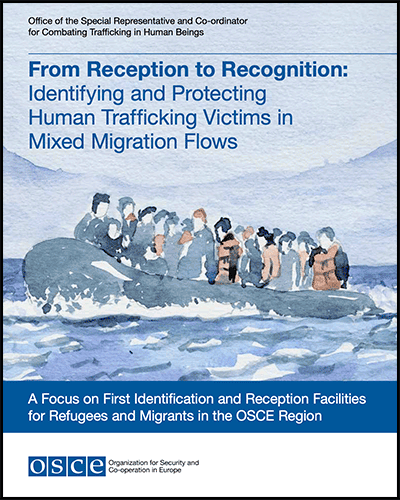
From Reception to Recognition: Identifying and Protecting Human Trafficking Victims in Mixed Migration Flows

The prolonged instability in the Middle-East, Sahel and North Africa has given rise to exceptional movements of migrants and refugees. Large mixed migratory flows have considerably affected receiving OSCE participating States, in particular countries along the Mediterranean and Balkan routes, making this essentially a European emergency. It is becoming increasingly evident that the current migration and refugee crisis creates a perfect market for the exploitation of migrants within transit and p destination countries by unscrupulous criminal syndi- cates and lone perpetrators.

READ THE REPORT

Model Guidelines on Government Measures to Prevent Trafficking for Labour Exploitation in Supply Chains

The aim of these model guidelines is to provide a practical tool to assist OSCE participating States and Partners for Cooperation to implement concrete measures to prevent trafficking in human beings in supply chains. It highlights how States can implement legislation and policies that promote transparency to ensure that public supply chains are free from trafficked labour; and promote the fair and ethical recruitment of workers.

READ THE REPORT

Compendium of relevant reference materials and resources on ethical sourcing and prevention of trafficking in human beings for labour exploitation in supply chains

The Compendium of Resources is divided into three sections. The first chapter includes State initiatives, such as laws, policies, national action plans, and guidelines developed by national authorities to address forced labour and human trafficking in supply chains. The second chapter looks at the work of NGOs, civil society, academia and the private sector regarding ethical sourcing and exploitation in supply chains. Finally, the third chapter reflects relevant initiatives of international organizations, including international treaties, political commitments, reports, publications, and others.

READ THE REPORT

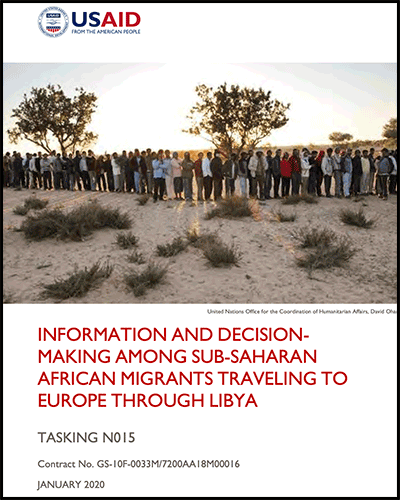
Information and Decision-Making Among Sub-Saharan Migrants Traveling to Europe through Libya

Arrivals to Europe from Africa, especially across the central Mediterranean route from Libya and Tunisia to Italy, have fallen since mid-2017. Most observers believe that European Union (EU) migration policies, particularly EU and Libyan interdiction measures as well as agreements between the EU and various governments, are responsible for the falling numbers of arrivals. Yet EU officials and many experts also believe that the underlying drivers of migration, including migrants’ hopes for better lives in Europe and/or migrants’ desires to flee oppressive regimes and conflict zones, are still firmly in place.

READ THE REPORT

Modern Slavery Act 2018 and associated matters

The task of this inquiry was to examine the New South Wales Modern Slavery Act 2018, which was passed by the NSW Parliament on 21 June 2018 and has yet to be proclaimed. The committee was also tasked with examining consultation drafts prepared by the NSW Government of the Modern Slavery Amendment Bill 2019 and Modern Slavery Regulation 2019. The committee expresses its support for the NSW Act, based on the evidence in this inquiry as to its many world-leading features. These include a robust supply chain transparency scheme for both business and government, an Anti-Slavery Commissioner, the creation of new modern slavery offences, support for victims and the establishment of a parliamentary committee to provide oversight of this important policy area.

READ THE REPORT

QUALITY AND RIGOR IN TIP RESEARCH IN THE MEKONG REGION: ASSESSING THE EVIDENCE BASE (2008-2018)

This research review compiled published research on the issue of trafficking in persons (TIP) in five of the Mekong countries – Cambodia, Lao PDR, Myanmar, Thailand and Viet Nam – between 2008 and 2018. This included both peer reviewed and “grey” literature4 accessed in library-based and internet searches according to a pre- determined set of criteria and based on specific keywords and research strings. They analyzed a total of 480 studies on trafficking in persons (TIP) in five of the Mekong countries published from 2008 to 2018.

READ THE REPORT

Endline research findings on fishers and seafood workers in Thailand

This endline survey shows the accomplishment of the integration between the public sector, employers, workers, and civil society, with a mutual ambition to prevent and eliminate trafficking in persons, child labour, forced labour, and unacceptable forms of work in Thailand’s fishing and seafood processing industries. Some of Thailand’s achievements have been revealed in the reports, such as the increasing of regular labour migration, lower costs for migration and higher wages. However, there are still gaps and challenges, and every partner in Thailand and neighbouring countries needs to work together to encourage fair and sustainable seafood industries along the global supply chains.

READ THE REPORT

Department of Homeland Security Strategy to Combat Human Trafficking, the Importation of Goods Produced With Forced Labor, and Child Sexual Exploitation

The United States has declared it a national priority to end human trafficking, the importation of goods produced with forced labor, and child sexual exploitation. The U.S. Department of Homeland Security is on the frontlines of this fight, protecting the country and collaborating with our partners to stop these crimes. To leverage all of our authorities in this fight, DHS developed a first-of-its-kind Strategy to Combat Human Trafficking, the Importation of Goods Produced with Forced Labor, and Child Sexual Exploitation. It represents our vision to end this urgent humanitarian issue, articulates the Department’s long-term approach for combating these crimes, and serves as a framework to prioritize our resources and monitor progress.

READ THE REPORT

Report of the OSCE Special Representative and Co-ordinator for Combating Trafficking in Human Beings: New Challenges and New Opportunities

The Office of the Special Representative and Co-ordinator for Combating Trafficking in Human Beings (OSR/CTHB) confronts human trafficking concretely and comprehen- sively, paying particular attention to its cross-dimensional nature and the OSCE’s focus on the intersection of secu- rity and human rights. Trafficking in human beings is not only a human rights violation but also a grave security concern. It generates cross-border and internal instability when the rule of law and human security are undermined through the exploitation of vulnerable people. Security and human rights in the OSCE region are threatened as long as the scourge of human trafficking persists.

READ THE REPORT

Review of Models of Care for Trafficking Survivors in Thailand

This report summarizes the findings of a Review of Models of Care for Trafficking Survivors that was completed by Winrock International (Winrock) in 2018-2019 under the United States Agency for International Development’s Thailand Counter Trafficking-in-Persons project. The research aimed to compare models of care available to trafficked persons (men, women, girls and boys, and lesbian, gay, bisexual, transgender, queer, and intersex [LGBTQI] people) in Thailand, and assess their relative effectiveness in victim recovery. The study also explored models used elsewhere that could be adapted to the Thailand context.

READ THE REPORT

Stolen freedom: the policing response to modern slavery and human trafficking

In the UK, today and every day, thousands of men, women and children who are victims of modern slavery and human trafficking are being degraded and dehumanised. These crimes are multi-faceted. Cases may involve single or multiple offenders or victims, and may be national or international, organised or opportunistic. They occur in both rural and metropolitan areas, in settings ranging from nail bars to construction sites, and involve activities from domestic servitude to the trafficking of children for sexual exploitation. It is imperative that police forces are aware of the signs and indicators of these most pernicious and frequently hidden of crimes so that they can respond in an appropriate manner.

READ THE REPORT