“Because if we talk about health issues first, it is easier to talk about human trafficking”; findings from a mixed methods study on health needs and service provision among migrant and trafficked fishermen in the Mekong

Human trafficking in the fishing industry or “sea slavery” in the Greater Mekong Subregion is reported to involve some of the most extreme forms of exploitation and abuse. A largely unregulated sector, commercial fishing boats operate in international waters far from shore and outside of national jurisdiction, where workers are commonly subjected to life-threatening risks. Yet, research on the health needs of trafficked fishermen is sparse.

This paper describes abuses, occupational hazards, physical and mental health and post-trafficking well-being among a systematic consecutive sample of 275 trafficked fishermen using post-trafficking services in Thailand and Cambodia. These findings are complemented by qualitative interview data collected with 20 key informants working with fishermen or on issues related to their welfare in Thailand.
READ THE REPORT

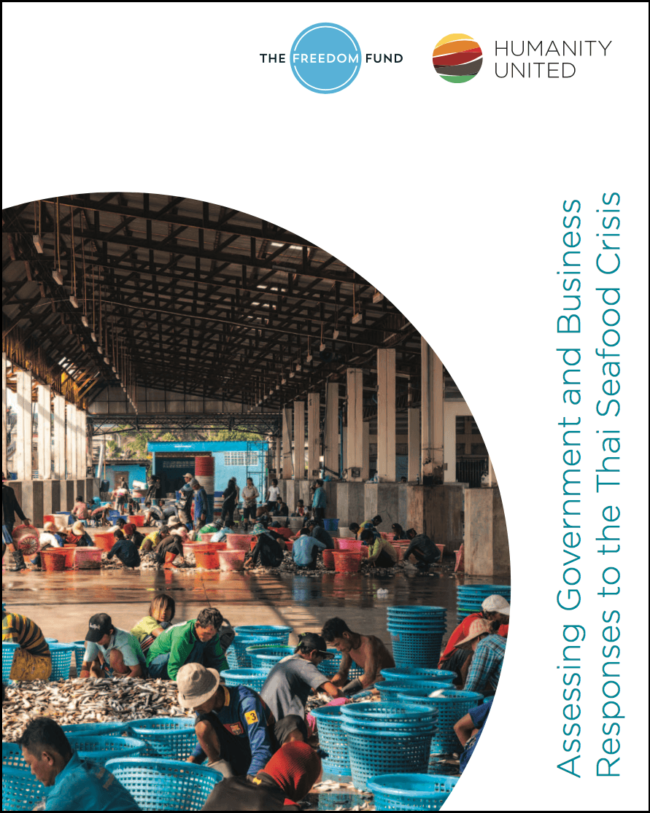
Assessing Government and Business Responses to the Thai Seafood Crisis

International focus on the Thai seafood industry has rapidly increased in recent years. The last two years in particular have seen a series of high profile reports that have damaged the industry’s reputation and put pressure on the Thai government. In June 2014, a six-month investigation by the Guardian newspaper culminated in an exposé linking one of Thailand’s largest companies and a number of leading American and European retailers to sh caught by slaves, which was used to feed the farmed shrimp they sold in the US and EU.

READ THE REPORT

Slavery at Sea: The Continued Plight of Trafficked Migrants in Thailand’s Fishing Industry

Provides recent examples of problems that have long plagued the industry in Thailand. Since the late 1980s, Thailand’s increasing prosperity and low unemployment rate have led many Thai citizens to turn away from low-paid work in the country’s more labour-intensive sectors, including construction, fishing and seafood processing. At the same time, Thailand’s comparatively underdeveloped neighbours have provided a cheap and plentiful supply of migrant labour, which has acted to discourage businesses from investing in labour-saving production processes.22 Consequently, entire sections of the Thai economy have become strongly reliant on migrant labour. Workers from Myanmar, Laos and Cambodia now constitute up to 10 per cent of Thailand’s workforce, and as much as 90 per cent in the seafood industry.

READ THE REPORT

List of Goods Produced by Child Labor or Forced Labor, 2014

U.S. Department of Labor’s Bureau of International Labor Affairs, Office of Child Labor, Forced Labor, and Human Trafficking. Who picked the cotton for the shirt on your back? Who cut the cane for the sugar in your co ee? Who red the kiln to make the bricks in your replace? The List contained in these pages originates from a simple conviction: none of the products we consume on a daily basis should be made by an adult who is forced to produce them or a child under conditions that violate international law.

READ THE REPORT