An Assessment of Sex Trafficking in Canada

The report answers diverse inquiries posed by the Canadian Women’s Foundation following their preliminary consultations with human trafficking stakeholders from 2011 to 2012. The purpose of the report is to provide a baseline from which the Task Force can work. The report gathers information on the prevalence of human trafficking in Canada in 2013, examines the profile of victims and the techniques of traffickers, and explores newer areas in the human trafficking discussion – such as the demand to purchase sex in Canada, the role of the internet in sex trafficking, and the social and economic costs of sex trafficking. More detailed reports in other topic areas, such as relevant laws, law enforcement and service provision will follow this report over the course of the year.

READ THE REPORT

Sexual Exploitation and Trafficking of Aboriginal Women and Girls – Literature Review and Key Informant Interviews

This research was prepared for the Canadian Women’s Foundation’s National Task Force on Trafficking of Women and Girls. This research will form a comprehensive picture on the state of human trafficking for sexual exploitation of Aboriginal women and girls in Canada. The review will help to inform the work of NWAC and the Canadian Women’s Foundation’s Task Force and aid in the Task Force’s preparations to identify and suggest key solutions for a national anti- trafficking strategy effectively addressing sexual exploitation of Aboriginal women and girls in Canada.

READ THE REPORT

Report from the National Roundtable on Service Delivery for Trafficked Women and Girls in Canada

On September 18th, 2013 the Canadian Women’s Foundation brought together 46 of Canada’s leading providers of services for trafficked women and girls. THE GOAL: To identify the services and system changes that could: prevent trafficking, respond to the immediate needs of trafficked womenand girls, and help women and girls leave exploitive situations andrebuild their lives. During this full-day roundtable, representatives from women’s, Aboriginal and immigrant-serving organizations, police departments, shelters, hospitals, community organizations and anti-trafficking initiatives generated hundreds of ideas, practices and recommendations. For many participants, this was their first chance to meet with their counterparts from across Canada. It was also a unique opportunity for police and nurses, shelter workers and women’s advocates to meet together as colleagues in the trafficking sector.

READ THE REPORT

“NO MORE”: Ending Sex-Trafficking In Canada – Report of the National Task Force on Sex Trafficking of Women and Girls in Canada

The Task Force was created and funded by the Canadian Women’s Foundation to investigate the nature and extent of sex trafficking in Canada, and to recommend a national anti-trafficking strategy to inform the work of the Canadian Women’s Foundation.

The findings and recommendations contained in this report were developed to assist the Canadian Women’s Foundation in creating its own five-year national anti-trafficking strategy. It is also hoped the recommendations will inform and offer guidance to other stakeholders working in this area.

READ THE REPORT

FROM HEARTBREAKING TO GROUNDBREAKING: Stories and Strategies to End Sex Trafficking in Canada

Girls, often as young as 13, are being lured, recruited and procured into sexual slavery by predators who profit from their endeavors, rob them of their dignity, and often wound them with lifelong scars, changing forever the trajectories of otherwise happy lives.

Poverty, violence and widespread gender inequity are the preconditions for trafficking, but not the only factors. Any one of the previously trafficked girls and women we have come to know could be our own daughter, our sister, our niece, our aunt. The diversity of those who are trafficked is sobering: Any girl, anywhere, at any time.

READ THE REPORT

The Geography of Trafficking in Tennessee 2013

Follow-up Report to the Tennessee Human Sex Trafficking and Its Impact on Children and Youth 2011. Profiles minor sex trafficking cases of Tennessee counties and provides statistical comparisons between cases reported from law enforcement and non-law enforcement responders. Additionally, this study analyzes data in counties that reported the highest numbers of minor sex trafficking. As of July 2013, twelve new anti-human trafficking laws have been created to address this epidemic. Domestic issues, the drug trade, poverty and other socio-economic factors serve as catalysts for human sex trafficking.

READ THE REPORT

A National Overview of Prostitution and Sex Trafficking Demand Reduction Efforts

Provides a descriptive overview of initiatives targeting the demand for commercial sex in the United States. It describes the process of gathering the information in this (and other) reports, discusses specific initiatives, and highlights selected communities to illustrate how and why their members have endeavored to address prostitution and sex trafficking by combating demand.

READ THE REPORT

WAHAYA: Domestic and Sexual Slavery in Niger

Focuses on the ‘wahaya’ practice in Niger, whereby girls and women of ‘slave caste’ are bought and sold as unofficial wives. They are referred to as ‘fifth wives’, as they are additional to the four wives permitted to Niger, but they are not officially married to their master and therefore have none of the legal rights and protection to which legal wives would have recourse. ‘Wahaya’ are essentially slaves used for domestic labour and sexual gratification.  The report presents testimonies from individual wahaya to expose the shocking realities of the practice and calls for efforts to end these forced unions.

READ THE REPORT

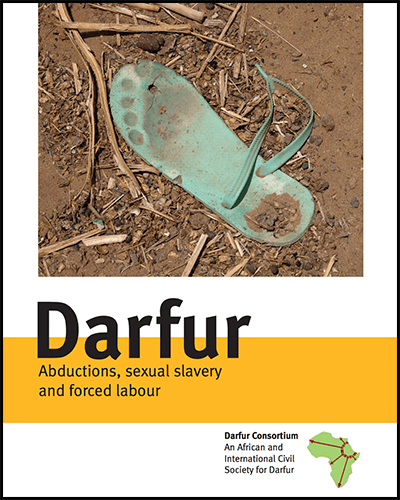
Darfur Abductions: Sexual Slavery and Forced Labour

Research by the Darfur Consortium has found that Government supported militia, like the Janjaweed and the Popular Defence Forces, together with the Sudanese Armed Forces, have systematically abducted civilians for the purposes of sexual slavery and forced labour as part of the Darfur conflict. The report investigates the pattern of abductions, the issues behind them, including ethnicity and lack of protection, and concludes with some recommendations to address the abductions.

READ THE REPORT

Transnational Legal Responses to Illegal Trade in Human Beings

Human trafficking, whether for the purpose of sexual exploitation or forced labor or services, is a transnational crime that requires trans-national responses, including what this paper will refer to as the three EX’s: exchange of information among countries of origin, transit, and destination; extraterritorial jurisdiction that extends to an act of trafficking regardless of the place in which it was committed; and extradition, a mechanism that ensures that a perpetrator of the crime will not be shielded from liability.

READ THE REPORT