How Footwear Companies and Luxury Brands Tackle Forced Labor Risks in Their Leather Supply Chains

This case study assesses how a sample of five footwear companies and five luxury clothing brands address forced labor risks across their leather supply chains. The study follows KnowTheChain’s first apparel and footwear benchmark which found a lack of transparency and action to address forced labor abuses beyond first-tier suppliers, particularly in leather.

READ THE REPORT

Forced Labor Action Compared: Findings From Three Sectors

Last year, KnowTheChain identified three sectors with the highest risk of forced labor in their supply chains and benchmarked 60 companies within those sectors. It was the first analysis of its kind, focusing specifically on forced labor risks and the corporate policies and practices developed by companies in response. In order to build on the momentum of this first set of reports, KnowTheChain worked to identify lessons and recommendations that can benefit companies across all sectors. This report is the product of those efforts.

READ THE REPORT

Financing Forced Labor

Sixty years have passed since the adoption of ILO Convention No. 105 (Abolition of Forced Labor Convention, 1957), yet a number of States have persisted in using forced labor for economic development, the eradication of which was a driving force behind establishing the Convention. Nowhere in the world is this problem more entrenched and pervasive than Uzbekistan.

READ THE REPORT

Human Trafficking and Public Corruption

Corruption is an endemic feature of human trafficking. It is common to both sex and labour trafficking. Corruption enables traffickers’ often-successful efforts to evade justice. Examples abound: a police officer demands a bribe to ignore the presence of a child in a brothel; an immigration official receives payment to provide a forged passport; a judge dismisses a trafficking case in exchange for a share of the traffickers’ profits; a law enforcement official deports a trafficking victim to prevent her testimony against a criminal defendant; a government official accepts a bribe to fraudulently provide residency permits for foreign workers.

READ THE REPORT

Food & Beverage Benchmark Findings Report: How are 20 of the largest companies addressing forced labor in their supply chains?

The food and beverage industry is an at-risk sector. Forced labor occurs both in the production of raw materials and during the food processing stages of food and beverage companies’ supply chains. Food commodities are produced by agricultural workers who often come from vulnerable groups such as women, international migrants, and internal migrants with little education. Weak labor laws and law enforcement in the sector, together with isolated workplaces where housing tends to be provided by the employer, aggravate the typically poor working conditions and can leave workers vulnerable and dependent on their employer.

READ THE REPORT

Forced Labor in the Production of Electronic Goods in Malaysia: A Comprehensive Study of Scope and Characteristics

Malaysia’s electronics sector workforce includes hundreds of thousands of foreign migrant workers who come to Malaysia on the promise of a good salary and steady work – an opportunity to make a better life for themselves and their families. But many are subject to high recruitment fees, personal debt, complicated recruitment processes, lack of transparency about their eventual working conditions, and inadequate legal protections. Unscrupulous behavior on the part of employers or third-party employment agents1 can exacerbate vulnerability to exploitation, but the system in which foreign workers are recruited, placed and managed is complex enough to create vulnerability even in the absence of willful intent to exploit.  The conditions faced by foreign electronics workers in Malaysia have the potential to result in forced labor. In 2012, Verité received funding from the US Department of Labor to conduct a study to determine whether such forced labor does, in fact, exist in the production of electronic goods in Malaysia.

READ THE REPORT

List of Goods Produced by Child Labor or Forced Labor, 2014

U.S. Department of Labor’s Bureau of International Labor Affairs, Office of Child Labor, Forced Labor, and Human Trafficking. Who picked the cotton for the shirt on your back? Who cut the cane for the sugar in your co ee? Who red the kiln to make the bricks in your replace? The List contained in these pages originates from a simple conviction: none of the products we consume on a daily basis should be made by an adult who is forced to produce them or a child under conditions that violate international law.

READ THE REPORT

Slavery on the High Street: Forced Labour in the Manufacture of Garments for International Brands

Identifies the use of slavery-like practices involved in the manufacture of garments in India for international markets: the use of forced labour of young women and girls in the factories of Southern India, particularly the spinning mills around Tirupur. Also identifies the routine use of child labour in garment finishing in Delhi. Details of international companies whose supply chains appear to be affected by some of these forms of forced labour are given in chapter four of this report.

READ THE REPORT

Forced Labour in North Korean Prison Camps

Focuses on returned North Korean migrants who are subjected to forced labour in North Korean prison camps following their deportation from China. The findings of the report are based on interviews carried out with North Koreans who were subjected to forced labour while in detention. The report includes photographs and 30 cases. Most of those interviewed were subjected to forced labour before being prosecuted, which violates international standards as well as North Korea’s domestic law. The report also outlines what measures need to be taken to address this situation.

READ THE REPORT
Trafficking in Women, Forced Labour and Domestic Work: In the Context of the Middle East and Gulf Region

Investigates the experiences of migrant domestic workers in the region, the dynamics and workings of the migration process and how migration (if at all) contributes to trafficking; and looks at what are some of the key inter-connecting dynamics involved between slavery, trafficking, migration and forced labour.
It focuses particularly on several selected sending, receiving and transit countries (Egypt, Ethiopia, Eritrea, Lebanon, Sudan and Yemen).

READ THE REPORT

Never Work Alone: Trade Unions and NGOs Joining Forces to Combat Forced Labour and Trafficking in Europe

Guide for trade unions and other civil society organisations to jointly combat modern-day slavery and trafficking of workers. The report is the result of a two-year project in which trade unions and NGOs have looked into each other’s actions and approaches to combat slavery and labour trafficking. It examines different approaches and shows four major common grounds for action, each of them documented with a series of best practices.

READ THE REPORT

Report of the Eastern and Horn of Africa Conference on Human Trafficking and Forced Labour

Details the proceedings and recommendations of the conference held in Nairobi from 5-7 July 2005. The conference discussed contributing factors to trafficking and forced labour, including armed conflict, debt bondage, education and child labour, drugs and transnational crime, and national and international adoption. It also examined various regional and international responses.

READ THE REPORT

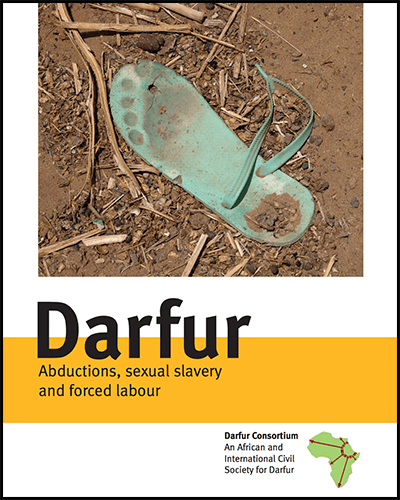
Darfur Abductions: Sexual Slavery and Forced Labour

Research by the Darfur Consortium has found that Government supported militia, like the Janjaweed and the Popular Defence Forces, together with the Sudanese Armed Forces, have systematically abducted civilians for the purposes of sexual slavery and forced labour as part of the Darfur conflict. The report investigates the pattern of abductions, the issues behind them, including ethnicity and lack of protection, and concludes with some recommendations to address the abductions.

READ THE REPORT

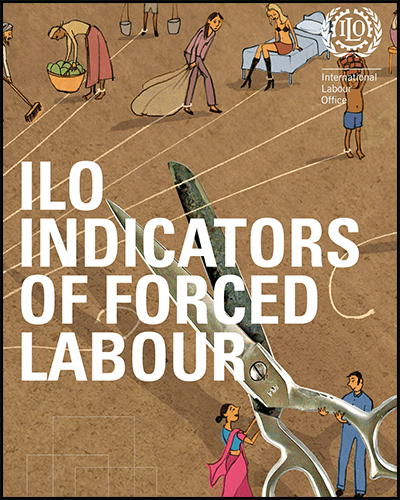
ILO Indicators of Forced Labour

Presents an introduction to the ILO Indicators of Forced Labour. These indicators are intended to help “front-line” criminal law enforcement officials, labour inspectors, trade union officers, NGO workers and others to identify persons who are possibly trapped in a forced labour situation, and who may require urgent assistance. The indicators represent the most common signs or “clues” that point to the possible existence of a forced labour case.

READ THE REPORT

2008 Vienna Forum Background Paper: Supply Management, Eliminating the Risks of Forced Labour and Trafficking

Provides background information on the issues of the ILO’s primary concern, with a particular focus on trafficking for forced labour exploitation, and raises questions for further discussion. It begins by discussing the concept of forced labour and assessing the current state of knowledge. This is followed by a discussion of demand factors, supply chain management issues and recruitment systems. A final section discusses concrete measures that can now be taken to prevent and identify forced labour, particularly by employers and workers in cooperation with other national and international partners.

READ THE REPORT