
Forced Labour in the 21st Century
Highlights the main ways in which forced labour manifests itself internationally, including through slavery, bonded labour, trafficking and child labour. Case studies and pictures are provided throughout.

Academic | Government | U.S. TIP | U.N. | NGO
Highlights the main ways in which forced labour manifests itself internationally, including through slavery, bonded labour, trafficking and child labour. Case studies and pictures are provided throughout.

Gives an insider’s view of how the ILO works. It explains how the ILO can be used by non-governmental organisations and other groups, to promote and protect minority and indigenous peoples’ rights.

Guide for trade unions and other civil society organisations to jointly combat modern-day slavery and trafficking of workers. The report is the result of a two-year project in which trade unions and NGOs have looked into each other’s actions and approaches to combat slavery and labour trafficking. It examines different approaches and shows four major common grounds for action, each of them documented with a series of best practices.

Legal guide by Anti-Slavery International and Eaves Poppy Project warns that victims of trafficking for forced prostitution and forced labour are vulnerable to being re-trafficked because of a failure of the criminal justice system to provide financial compensation for their ordeal. The guide aims to be a starting point to help lawyers take a creative and comprehensive approach in evaluating the legal remedies available to trafficking victims. It also includes two practical case studies and recommendations drawn from the experience of several practitioners.the system.

Identifies the legal remedies available to trafficked persons in England and Wales and analyses the effectiveness of each remedy viewed in light of its accessibility to trafficked persons.

Reviews the experience of eight specific countries and attempts to assess what the impact of anti-trafficking measures have been for a variety of people living and working there, or migrating into or out of these countries. The eight are: Australia, Bosnia and Herzegovina (BiH), Brazil, India, Nigeria, Thailand, the United Kingdom (UK) and the United States (US). The chapters look specifically at what the impact has been on people’s human rights.

In October 2006, Anti-Slavery International ,CICA, IEPALA, MLAL Progetto Mondo and OIKOS participated in a two-day conference in Verona, Italy, as part of the “Hands Up for Freedom” project. Partners were invited from various countries and papers were presented on topics relating to the conference theme, “When People are treated as Commodities in the Global Market”. This report is a summary of some of the information made available during the conference in Verona.

Details the proceedings and recommendations of the conference held in Nairobi from 5-7 July 2005. The conference discussed contributing factors to trafficking and forced labour, including armed conflict, debt bondage, education and child labour, drugs and transnational crime, and national and international adoption. It also examined various regional and international responses.

In March 2005, Anti-Slavery International and other non-governmental organisations including CICA, IEPALA, MLAL Progetto Mondo and OIKOS took part in a conference in Lisbon, Portugal. The issues of trafficking and migration in Italy, Portugal, Spain and the United Kingdom were discussed, including the current siutation, government action and recommendations for change. Global partners presented papers on topics relating to the conference’s theme. The report is a summary of information made available during the conference.

Exposes the vulnerability of North Korean women who flee to China to trafficking. A wide range of case studies documents trafficking into sexual exploitation and forced and ‘arranged’ marriages. It makes a case for North Koreans in China to be considered refugees and concludes with recommendations of what action needs to be taken.

ECPAT UK’s latest report on child trafficking into the UK. Cause for Concern? includes interviews with social services in all 33 of London’s boroughs to gauge social workers’ awareness of trafficking and record cases of children who have been trafficked to the capital. Twenty-six boroughs reported that they had worked directly with children who had been trafficked or who had been brought into the UK and were living in suspicious circumstances. It includes case studies, statistics and recommendations.
Amnesty International and Anti-Slavery International assess some of the articles in the draft of the European Convention on Action Against Trafficking in Human Beings in relation to existing international standards and commitments.

Publication seeks to look at the issue of trafficking within a broader migration framework and to propose policies which would be effective in reducing trafficking and in preventing the human and labour rights violations to which migrant workers are so often subjected today.

Information of activities and services offered by organisations around the world that are working towards the elimination of human trafficking. It aims to facilitate co-operation and the establishment of networks and partnerships, aid effective referral for trafficked people (psychological counselling, long-term shelter provision and skills training), assist personnel who have identified a victim of trafficking to make contact with relevant service providers and provide an overview of the trafficking situation in each country. Also provides background on legislation and the types of services provided by organisations and institutions in this area.
READ THE REPORT

NGOs from five Western European countries — Germany (KOK) , Greece (STOP NOW), Italy (On the Road), The Netherlands (STV) and United Kingdom (Eaves Housing for Women and Anti-Slavery International) — presented this joint statement on protection measures for trafficked people at the OSCE Human Dimension Implementation Meeting in Warsaw in October 2003.

Includes a Code of Conduct for improving the treatment of child domestic workers and child victims of trafficking, as well as recommendations for action. Anti-Slavery International set up a network of child rights organisations in six West and Central African countries: Bénin, Burkina Faso, Gabon, Ghana, Niger and Togo, in order to strengthen their ability to work together for the eradication of abusive forms of work and the worst forms of child labour.

Looks at measures to protect trafficked people in Belgium, Colombia, Italy, the Netherlands, Nigeria, Poland, Thailand, Ukraine, the UK and US. It includes case studies, documents good and bad treatment by authorities and concludes with recommendations.

Looks at slavery and child labour particularly within the cocoa and carpet industries. It sets out possible solutions, focusing on fair trade and ethical trade and action you can take.

Focuses on the ‘wahaya’ practice in Niger, whereby girls and women of ‘slave caste’ are bought and sold as unofficial wives. They are referred to as ‘fifth wives’, as they are additional to the four wives permitted to Niger, but they are not officially married to their master and therefore have none of the legal rights and protection to which legal wives would have recourse. ‘Wahaya’ are essentially slaves used for domestic labour and sexual gratification. The report presents testimonies from individual wahaya to expose the shocking realities of the practice and calls for efforts to end these forced unions.
Highlights what action needs to be taken by governments and other international agencies to ensure that every human being – without exception – should be able to live a life free from slavery.

Gives an overview of the Transatlantic Slave Trade and considers the factors that led isolated voices of protest to develop into a popular movement in less than 20 years, helping to bring about the abolition of the slave trade in 1807. It also traces how after the end of the Transatlantic Slave Trade, new forms of slavery began to manifest themselves and how they were challenged through popular campaigns and the development of international standards to prohibit them. It also considers what action needs to be taken to free the millions of people in slavery today.

Study on slavery in Niger.
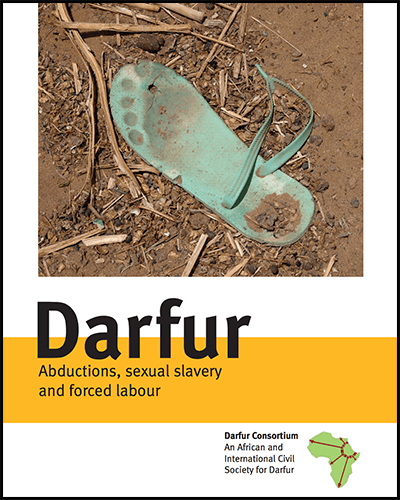
Research by the Darfur Consortium has found that Government supported militia, like the Janjaweed and the Popular Defence Forces, together with the Sudanese Armed Forces, have systematically abducted civilians for the purposes of sexual slavery and forced labour as part of the Darfur conflict. The report investigates the pattern of abductions, the issues behind them, including ethnicity and lack of protection, and concludes with some recommendations to address the abductions.
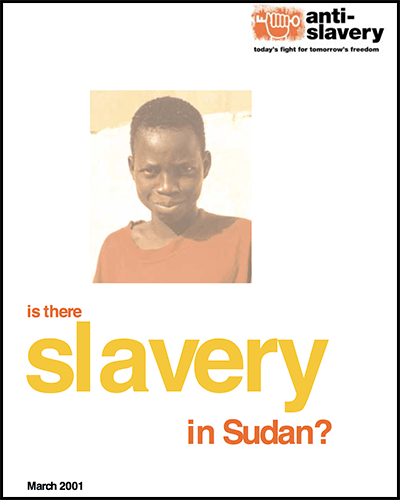
Summarises information obtained during a fact-finding visit to investigate abductions and slavery in Sudan. It includes illustrated case studies and the Sudan Government’s response.