Covid-19 and Supply Chains: Are we sacrificing standards at the moment they are needed most?

The impacts of Covid-19 are being felt throughout every tier of global supply chains. There are reports of factory shutdowns, order cancellations, workforce reductions and other disruptions. In turn, these have led to structural changes in supply chains, increased demand with tighter turnarounds and higher costs. Companies are now having to procure from new, unvetted suppliers, with potentially reduced staff and resourcing for due diligence.

Financing Forced Labor

Sixty years have passed since the adoption of ILO Convention No. 105 (Abolition of Forced Labor Convention, 1957), yet a number of States have persisted in using forced labor for economic development, the eradication of which was a driving force behind establishing the Convention. Nowhere in the world is this problem more entrenched and pervasive than Uzbekistan.

READ THE REPORT

Human Trafficking and Public Corruption

Corruption is an endemic feature of human trafficking. It is common to both sex and labour trafficking. Corruption enables traffickers’ often-successful efforts to evade justice. Examples abound: a police officer demands a bribe to ignore the presence of a child in a brothel; an immigration official receives payment to provide a forged passport; a judge dismisses a trafficking case in exchange for a share of the traffickers’ profits; a law enforcement official deports a trafficking victim to prevent her testimony against a criminal defendant; a government official accepts a bribe to fraudulently provide residency permits for foreign workers.

READ THE REPORT

Food & Beverage Benchmark Findings Report: How are 20 of the largest companies addressing forced labor in their supply chains?

The food and beverage industry is an at-risk sector. Forced labor occurs both in the production of raw materials and during the food processing stages of food and beverage companies’ supply chains. Food commodities are produced by agricultural workers who often come from vulnerable groups such as women, international migrants, and internal migrants with little education. Weak labor laws and law enforcement in the sector, together with isolated workplaces where housing tends to be provided by the employer, aggravate the typically poor working conditions and can leave workers vulnerable and dependent on their employer.

READ THE REPORT

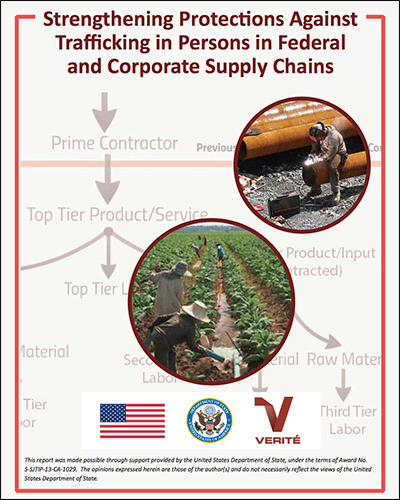
Strengthening Protections Against Trafficking in Persons in Federal and Corporate Supply Chains

The EO requires prime contractors providing large overseas contracts to develop and maintain detailed anti-trafficking compliance programs and provide annual certification of their anti- trafficking efforts.

To assist United States Government agencies and the federal contracting community to prepare for implementation of the EO and new FAR rules, the United States Department of State’s Office to Monitor and Combat Trafficking in Persons (DOS/J/TIP) asked Verité to investigate and map out the risk of trafficking in global supply chains generally, and in federal supply chains in particular.

READ THE REPORT

2008 Vienna Forum Background Paper: Supply Management, Eliminating the Risks of Forced Labour and Trafficking

Provides background information on the issues of the ILO’s primary concern, with a particular focus on trafficking for forced labour exploitation, and raises questions for further discussion. It begins by discussing the concept of forced labour and assessing the current state of knowledge. This is followed by a discussion of demand factors, supply chain management issues and recruitment systems. A final section discusses concrete measures that can now be taken to prevent and identify forced labour, particularly by employers and workers in cooperation with other national and international partners.

READ THE REPORT