
Migrant Smuggling in Asia – A Thematic Review of Literature
Provides a systematic review of available empirical knowledge on smuggling of migrants.

Provides a systematic review of available empirical knowledge on smuggling of migrants.

U.S. Department of Labor’s Bureau of International Labor Affairs, Office of Child Labor, Forced Labor, and Human Trafficking. Who picked the cotton for the shirt on your back? Who cut the cane for the sugar in your co ee? Who red the kiln to make the bricks in your replace? The List contained in these pages originates from a simple conviction: none of the products we consume on a daily basis should be made by an adult who is forced to produce them or a child under conditions that violate international law.

A study of the reasons why bonded labour, a contemporary form of slavery, persists in India, Nepal and Pakistan. In particular, it examines the effectiveness of state interventions against bonded labour.
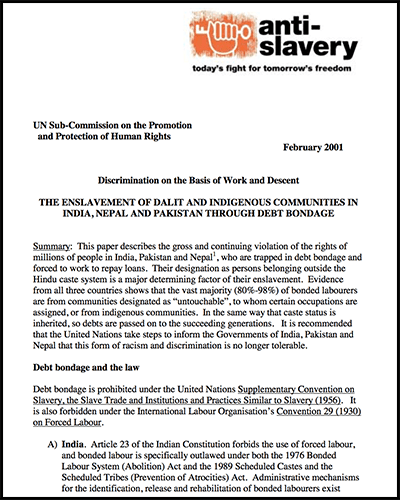
Describes the gross violation of the rights of millions of people in India, Pakistan and Nepal who are trapped in debt bondage and forced to work to repay loans. It explores evidence which shows that 80-98 per cent of bonded labourers are from communities designated as dalits.

Based on interviews with around 3,000 children the report is a study into the psychosocial wellbeing of child domestic workers across six countries in three continents (Peru, Costa Rica, Togo, Tanzania, India and Philippines).

Based on research conducted in Albania and Greece, India and Senegal, and looks at the phenomenon of forced child begging both in its local specifics and global commonalities. Forced child begging involves forcing boys and girls to beg through physical or psychological coercion.

The product of group discussions and individual interviews with more than 400 current and former child domestic workers from urban and rural areas in Benin, Costa Rica, India, Nepal, Peru, Philippines, Tanzania and Togo, to inform about the situation and needs of child domestic workers in order to better target programmes and policies on the issue.

Reviews the experience of eight specific countries and attempts to assess what the impact of anti-trafficking measures have been for a variety of people living and working there, or migrating into or out of these countries. The eight are: Australia, Bosnia and Herzegovina (BiH), Brazil, India, Nigeria, Thailand, the United Kingdom (UK) and the United States (US). The chapters look specifically at what the impact has been on people’s human rights.

Information of activities and services offered by organisations around the world that are working towards the elimination of human trafficking. It aims to facilitate co-operation and the establishment of networks and partnerships, aid effective referral for trafficked people (psychological counselling, long-term shelter provision and skills training), assist personnel who have identified a victim of trafficking to make contact with relevant service providers and provide an overview of the trafficking situation in each country. Also provides background on legislation and the types of services provided by organisations and institutions in this area.
READ THE REPORT

Bangladesh, India, Nepal and Sri Lanka have all taken steps in the right direction to combat human trafficking; however, there is a need to look closely at country specific laws to understand where the gaps lie. It is in the light of this, that a Legal and Policy Review of Responses to Human Trafficking has been taken up. The Report looks at the law and policy, especially in the context of the Protocol, supplementing work already available in different studies.

An educational tool to aid understanding of the trafficking in persons phenomena, divided into six sections.