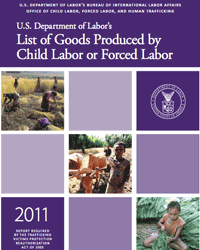
List of Goods Produced by Child Labor or Forced Labor, 2014

U.S. Department of Labor’s Bureau of International Labor Affairs, Office of Child Labor, Forced Labor, and Human Trafficking. Who picked the cotton for the shirt on your back? Who cut the cane for the sugar in your co ee? Who red the kiln to make the bricks in your replace? The List contained in these pages originates from a simple conviction: none of the products we consume on a daily basis should be made by an adult who is forced to produce them or a child under conditions that violate international law.
READ THE REPORT

Slavery on the High Street: Forced Labour in the Manufacture of Garments for International Brands

Identifies the use of slavery-like practices involved in the manufacture of garments in India for international markets: the use of forced labour of young women and girls in the factories of Southern India, particularly the spinning mills around Tirupur. Also identifies the routine use of child labour in garment finishing in Delhi. Details of international companies whose supply chains appear to be affected by some of these forms of forced labour are given in chapter four of this report.

READ THE REPORT

Ending Child Trafficking in West Africa: Lessons From the Ivorian Cocoa Sector

Finds that trafficking of children to cocoa farms in Côte d’Ivoire still occurs. The research found significant numbers of young people in Mali and Burkina Faso who had worked as children in cocoa farms in Côte d’Ivoire in the last five years. The practices occur in the context of large-scale movements of people within the region including the trafficking of children to other  agricultural activities and to other sectors.

READ THE REPORT

Sub-Regional Project on Eradicating Child Domestic Work and Child Trafficking in West and Central Africa

Includes a Code of Conduct for improving the treatment of child domestic workers and child victims of trafficking, as well as recommendations for action. Anti-Slavery International set up a network of child rights organisations in six West and Central African countries: Bénin, Burkina Faso, Gabon, Ghana, Niger and Togo, in order to strengthen their ability to work together for the eradication of abusive forms of work and the worst forms of child labour.

READ THE REPORT

Implementing the Roadmap for Achieving the Elimination of the Worst Forms of Child Labour by 2016: Training guide for policy makers

Provides the core building blocks of a comprehensive training programme that facilitates dialogue, understanding and increased capacity to end child labour, with an emphasis on its worst forms. It is designed to help national governments, the social partners and other stakeholders to work together to develop or improve their own national roadmap and adopt and sustain new and effective policy measures, as a matter of urgency. NOTE: clicking the link downloads the PDF file to your device.

READ THE REPORT